Training for vessel operators
In an inspection, every rule becomes a line in a report, or nothing at all.
A container ship sails under one flag, is surveyed by a class society, calls at ports in several states and reports under EU law. Four authorities, one crew, the same fourteen hours a day that maritime labour law allows. Seventeen courses that sort those four layers the way they actually turn up on board and ashore.
Assigned by role with a deadline · certificate per person · SCORM export to your onboard system · hosted in the EU
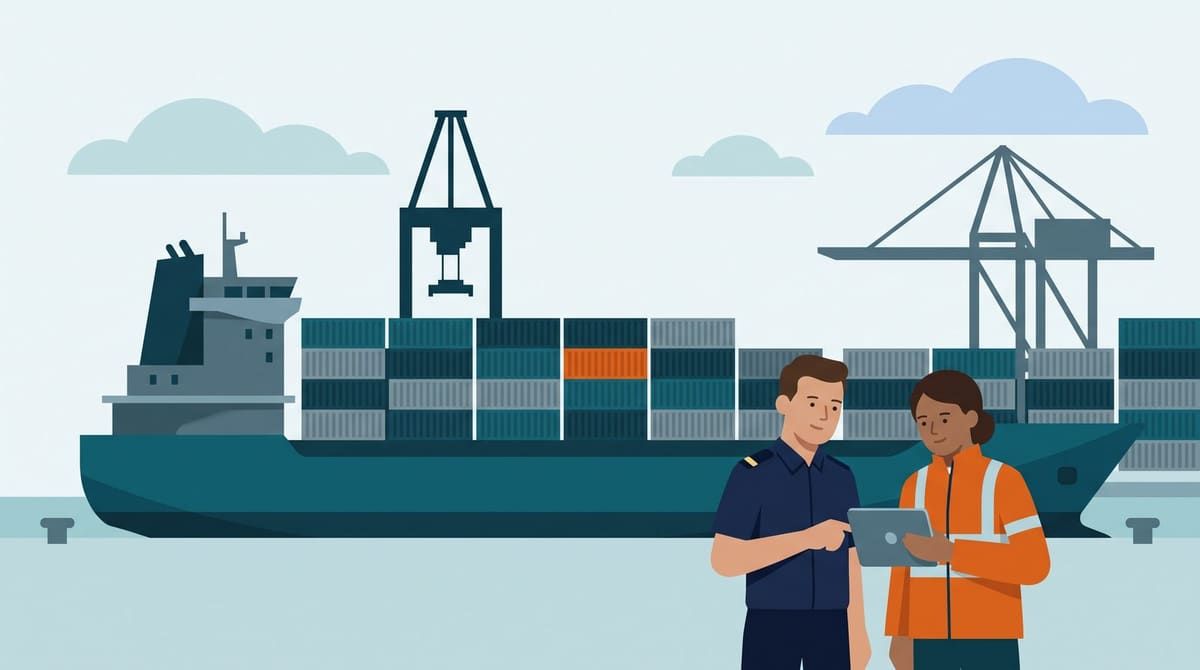
Explainer film
Two minutes, the same three people.
The film shows how a rule becomes a course, and how an inspection goes for someone who prepared for it.
How it is cut
One package is what you must do. The other is what someone checks.
The seventeen courses could have been sorted by area of law. That would be the structure of a legal commentary, not of an operation. Instead they are split by when the obligation lands on your desk: out of your own operation, or because someone comes aboard and asks.
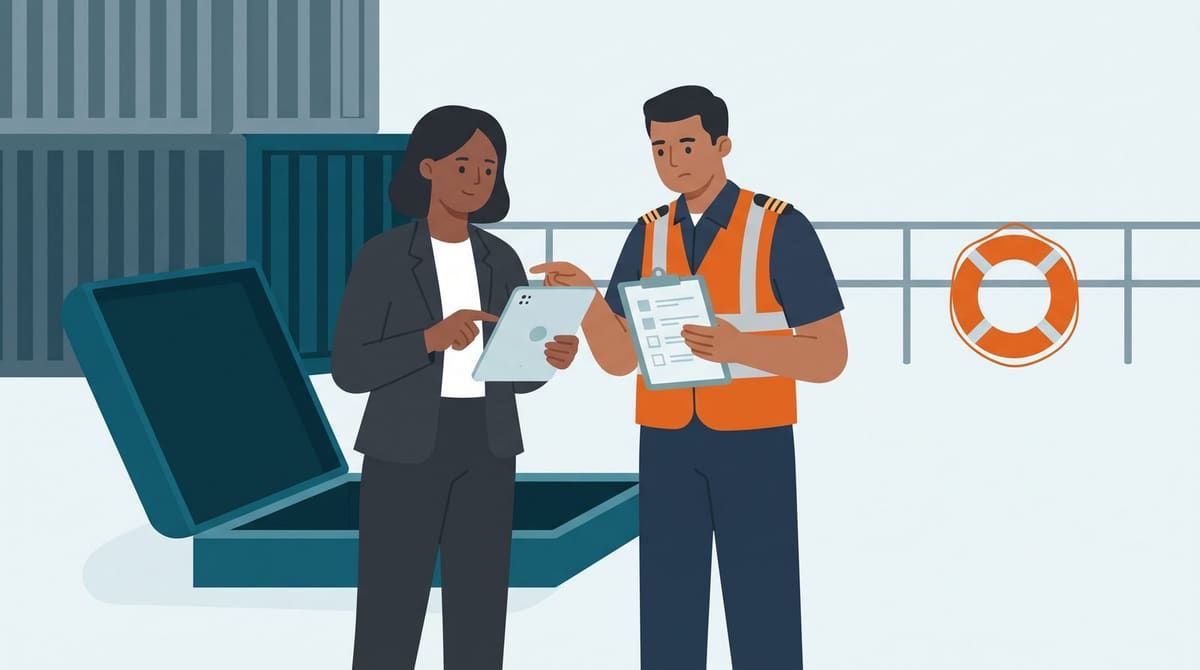
Cargo, crew, operation
What you carry, whom you employ, what you emit, whom you may trade with, and how you run the ship as a system. Nine courses that exist because you sail.
Port state control is where everything in Package A becomes either a deficiency or nothing.
B1 joins the two packagesControl, evidence, environment
Inspection, class, certificates, casualty investigation, limit values, waste and reporting. Eight courses in which someone from outside inspects, certifies or expects a report.
What it hinges on in practice
Six points this offer has to be measured against.
Training in shipping rarely fails on the subject matter. It fails on turnover, on bandwidth, on four authorities asking the same question differently, and on the fact that the obligations are all arriving at once.
The crew changes, the obligation stays
Whoever was briefed in March sails on another ship in June, or for another company. Knowledge that sits with people leaves the company with them.
Assignment is per person with a deadline, evidence is per person with a certificate. The record stays in your organisation even when the person is no longer aboard.
Four authorities ask the same thing, differently
Flag state, class society, port state and EU law interlock in the same operation. Training that serves only one of the four does not help during an inspection.
The seventeen courses cover all four layers, and the port state control course explains exactly how the other sixteen turn into a deficiency, or do not.
Bandwidth is expensive at sea
Training that assumes a stable connection is not training at sea. And an onboard system that already works will not be replaced for one supplier.
Every course exports as a SCORM 1.2 or SCORM 2004 package and runs in your existing onboard system. Whoever uses the platform does so in a browser: whoever does not still gets the course.
The pile arrives all at once
Emissions trading, FuelEU Maritime and NIS2 fall into the same two years as the standing duties from ISM, ISPS and maritime labour law. None is unmanageable on its own; together they nearly are.
That is why it is two packages and not one bundle: you can start with whatever bites first in your trade and add the rest later.
The master is the addressee almost everywhere
Eleven of the seventeen courses address the ship’s command. That is not a bias in the curriculum, it is the law, and for the person on the bridge it is a lot of time.
No course runs longer than fifty minutes, each stands on its own, and assignment follows the role rather than the package. Whoever is responsible only for cargo sees only that.
Training is not legal advice, but it has to hang on the text
Secondary literature copies from itself. For a rule that can lead to a detention, the second hand is one hand too many.
Every course stands on the source itself, retrieved article by article and forced into a source tree before a single line of course exists. What the course says can be traced back to the article.
Price
Per vessel, not per head.
A shipping company counts in vessels: management fee per vessel per day, insurance per vessel, class per vessel. And a crew rotates: one berth is two to two and a half people over a year. A price per head would mean administering a licence at every crew change. So we count vessels.
| Fleet | Package A | Package B | Both | You save |
|---|---|---|---|---|
| 1–3 vessels | 1,190 € | 1,060 € | 1,800 € | −20 % |
| 4–10 vessels | 1,050 € | 950 € | 1,600 € | −20 % |
| 11–25 vessels | 920 € | 830 € | 1,400 € | −20 % |
| 26 vessels and up | 790 € | 710 € | 1,200 € | −20 % |
Per vessel and year, net of VAT. The volume price applies to the whole fleet: book twelve vessels and all twelve are charged at the third band. Any fleet size can be booked; for a tailored scope, further languages or integration with an existing onboard system, talk to us first.
The crew including rotation and the vessel’s shore organisation. The number is a ceiling against misuse, not a pricing step. It does not bite for a real ship’s crew. A crew change costs nothing and reports nothing.
Twelve-month term, renewing automatically for twelve months, cancellable with two months’ notice to the end of the term. The obligations come back every year and the crew changes every year. A one-off training would be worthless in year two.
The discount hangs on the contract, not on the purchase date: book A first and add B later and you get it too: otherwise the existing customer would be the one penalised.
The curriculum
Seventeen courses, none longer than fifty minutes.
Each course stands alone and ends with a final test and a certificate. No course requires another. The legal basis is in every one of them, because in practice nobody follows the order a curriculum assumes.
Cargo, crew, operation
9 courses · 405 min.These nine obligations arise from running the ship: from what is in the containers, from the crew’s contracts, from the fuel in the tank, from the question of who the consignee is, and from the two management systems that hold the ship together.
Dangerous goods at sea
When a good counts as dangerous, who carries which duty, and what must be in place before loading
IMDG Code · GGVSee (DE)
Deck officers, cargo officers on board and dangerous goods safety advisers ashore
Maritime labour law on board and in crewing
The crew’s rights and the owner’s duties in day-to-day operation
MLC 2006 · SeeArbG (DE)
Crew members of all ranks as well as crewing and personnel administration ashore
Weighing and verified gross mass
Why a container without a verified gross mass may not be loaded, and who supplies it
SOLAS VI/2: VGM
Cargo planning, packing operations and terminal staff
EU emissions trading and MRV for shipping companies
Which voyages are covered, what is monitored and reported, and who surrenders
EU ETS · MRV Regulation 2015/757
Masters, technical inspectors and the company’s commercial administration
FuelEU Maritime
The greenhouse gas intensity of the energy used, and what it means in operation
Regulation (EU) 2023/1805
Technical management, bunker managers and compliance ashore
Sanctions and trade controls
How to recognise a sanctions-relevant transaction and what to do then
Regulation (EU) 833/2014
Chartering, customer onboarding, finance and the ship’s command
Competition law in liner shipping
What cooperation between liner carriers may do, and where the line runs
Consortia BER 906/2009 (until 2024)
Sales, chartering, network planning and management
ISM and ISPS on board and ashore
Two management systems, one operation: safe ship operation and maritime security
ISM Code · ISPS Code
Ship’s command, safety officers on board and the Designated Person Ashore
NIS2 in port and shipping operations
Cyber security as an operating duty: risk management, reporting and management liability
Directive (EU) 2022/2555: NIS2
IT and OT managers, company management and the ship’s command
Control, evidence, environment
8 courses · 350 min.These eight are about the view from outside: the inspection in port, the recognised organisation, the investigation after a casualty, certificates of competency, limit values for air pollutants, the delivery of waste, the end of the ship’s working life and the reports to customs and authorities.
Port state control: prepared for the inspection
How an inspection runs, what a ship is detained for, and what to do beforehand
Directive 2009/16/EC
Masters, chief officers, technical inspection and the Designated Person Ashore
Classification, survey and certificates
What a recognised organisation may do, what it certifies and what the flag state answers for
Regulation (EC) 391/2009
Technical inspection, ship management and newbuilding supervision
Marine casualties: investigate, report, learn
What counts as a reportable casualty, who investigates and what the findings are for
Directive 2009/18/EC
Ship’s command, safety officers on board and the shore organisation
Training, certificates of competency and watchkeeping
Which certificate applies to what, how it is recognised, and what watchkeeping requires
Directive (EU) 2022/993: STCW
Crewing, personnel administration and the ship’s command
Sulphur content and air pollutants
Which limit applies where, how it is evidenced, and what applies when fuel is unavailable
Directive (EU) 2016/802
Technical management, bunker managers and the ship’s command
Ship waste and port reception facilities
What must be notified before arrival, what must be delivered, and what may stay on board
Directive (EU) 2019/883
Ship’s command, cargo officers and port planning
Ship recycling and the inventory of hazardous materials
Why every ship needs an inventory of hazardous materials, and what applies at the end of its life
Regulation (EU) 1257/2013
Technical management, ship management and company management
Customs procedures and reporting formalities
The customs side of a port call and the single report that serves every authority
UCC · EMSWe
Chartering, documentation, agency and port planning
Which of the seventeen apply to you?
That depends on three things: which flag you sail under, which ports you call at and whether you carry dangerous goods. Send us those three and you get a list of the courses that apply to your fleet, and of the roles they should be assigned to.
Assignment
Nobody gets seventeen courses.
Assignment follows the role, not the package. This table is the starting distribution, it shifts with trading area and cargo, and that is exactly what we discuss when we cut it to fit.
The ship’s command appears in eleven of the seventeen courses. That is not a bias in the curriculum but the law. The master is an addressee in almost every one of the twenty-one rules.
How the courses are made
First the legal text, then the course, in that order.
In legal subjects the most common source of error is not the language but the source: secondary literature copies from itself. So between the rule and the course there is an enforced intermediate step that nobody can skip.

Official text
German rules via gesetze-im-internet.de, EU law via the Publications Office’s Cellar, retrieved article by article and measured in length, not summarised.
Source tree
The text becomes a tree that carries the citation in every node. Without it generation aborts. A generator without a tree invents its own structure.
Course
Only then the course, with a final test and a certificate. Every statement can be traced to a node of the tree and from there to the article.
Of the 24 sources, nineteen are legal texts; for verified gross mass (A3) there is a dedicated technical script underneath, because SOLAS as an IMO convention is not freely available, with a reference section and the German administrative layer from the rulings of the BG Verkehr. Where a rule was only available in its original version, the course teaches the structure and points to the consolidated version rather than asserting one snapshot.
The cast
The same three people, seventeen courses long.
The courses are told, not lectured: a situation on board or in the office, two people who have to decide something. The cast is fixed for both packages and does not change from course to course: whoever works through all seventeen meets three familiar faces instead of seventeen strangers.
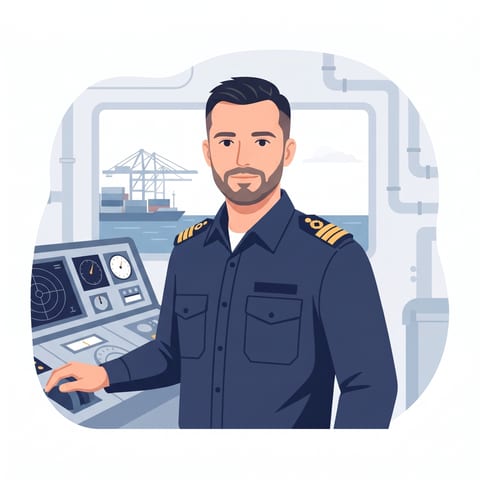 Marek KowalskiChief officer on a container ship
 Aynur DemirCompliance manager at a shipping company ashore
 Henning RothTerminal and cargo planner in port
Vessel record
The ship is the team.
Crews are held in the platform as a team per vessel. That makes it possible to say, for any point in time, which records this ship with this crew held, not only who is aboard today. After an incident that is the difference between a statement and evidence.
Access on board
Without a company e-mail address, too.
A large part of the crew has no company address, and access that must run through a mailbox reaches exactly those people last. Each person therefore gets their own QR code and signs in with it, without giving an e-mail address. The record still hangs on the person and on the vessel.

White paper
The analysis to read at leisure.
The four authorities and how they hand over to each other, the obligations with their citations, and the points where practice most often fails. Free of charge.
Download the white paper →Status and availability
All seventeen courses are finished: narration, moving images and final test included.
Structure, content, final tests, sources AND media are in place for all seventeen courses. They are available right now: during the fourteen-day trial you see every one of them in full, and which ones apply to your fleet is what the scoping call settles.
The courses are available in German and English. Every other language on this list we provide within a few days, free of charge, for the shore organisation as much as for the crew on board. Plus the languages your crews actually speak, even where they are not on this list: Filipino, Hindi, Indonesian, Ukrainian, Russian, Chinese, Burmese and Vietnamese. Translations are produced in the platform as a text layer over the same structure: a language version is not a second course, and the media stay in the same places. Just tell us in your enquiry which languages your crews speak.
Legal status September 2026. The courses provide general information and do not replace legal advice; they explain the rule and its application, they do not decide an individual case.