
Why a completed course does not authorise crane operation
A steel service centre is planning its late shift. An experienced colleague is absent, a new employee has completed an online course, and several bundles of beams are waiting in the warehouse. May she operate the overhead crane or attach loads? A course certificate cannot answer that question. The decision depends on the task, demonstrated knowledge and skills, site-specific instruction and appropriate authorisation. These conditions must be checked before independent work begins.
This guide concerns German steel operations and their shift supervisors, HR teams and occupational-safety specialists. It provides an organisational decision process, not instructions for executing a particular lift. The article on online occupational safety instruction explains the broader limits of digital learning. Here the narrower question is which evidence supports which decision, and when work must remain restricted. The employer's risk assessment and the equipment manufacturer's instructions remain essential.
Check four separate elements
Instruction communicates the hazards and protective measures relevant to the actual workplace. Section 12 ArbSchG requires instruction tailored to the workplace or duties, including before starting work after recruitment, changed duties or the introduction of new equipment. A generic presentation about cranes therefore cannot replace instruction about the particular hall, traffic routes and reporting arrangements. Asking employees to explain the stop rule in their own words is a practical recommendation, not a prescribed statutory form.
Qualification develops the necessary knowledge and practical skills. Equipment-specific familiarisation applies them to the particular machine and workplace. Authorisation defines which duties the employer actually assigns. These terms do not describe four universally named legal certificates: DGUV Principle 309-003 also uses the German term Unterweisung for theoretical and practical qualification. In operational decision-making, the demonstrated content therefore matters more than the heading printed on a certificate.
For crane operators, section 29 of DGUV Regulation 52 specifies conditions for independent operation, including suitability, instruction, demonstrated competence and reliability, alongside authorisation. Its express written-authorisation requirement for mobile powered cranes is not a complete statement of every current documentation requirement. In particular, do not infer a blanket exemption for other cranes. Assess the intended operation against the applicable rules and record the scope and limits of the assignment clearly.
The same competence boundary applies to slinging loads. DGUV Rule 109-017 describes qualification with theoretical and practical components; its scope and duration depend on equipment, risks and previous experience, among other factors. Current BGHM guidance also explains written authorisation in connection with the technical rules. A short knowledge test alone does not demonstrate practical competence for the intended slinging tasks. Avoid applying one course duration indiscriminately to every load and working environment.
 AI-generated
Turn a staff list into task-specific approval
Do not start by asking who holds some form of crane certificate. First describe the actual duties: operating a particular overhead crane, attaching specified load types, giving agreed signals or coordinating the work area. One person may hold several roles, but each needs an appropriate basis. Our overview of mandatory employee training supports general allocation. The operational approval matrix must then be more specific than that overall training plan and match the actual assignment.
A useful matrix records each person's role, covered crane type or lifting accessories, evidenced qualification, local familiarisation, instruction status and responsible approval. Explicitly identify excluded tasks, such as different controls or special loads. Link each field to its supporting record instead of a single green tick. Organising training records without spreadsheets can help, but a learning system must not automatically turn completed theory into permission to perform operational work.
Make responsibility for each decision explicit. HR keeps records available and flags gaps; suitably qualified responsible people assess practical competence; the employer's authorised representative decides the assignment. The relevant shift supervisor checks that the person, task and current conditions match. Our discussion of accountable delegation comes from facility management, but its organisational principle is useful here too: selection, clear limits and oversight belong together. That analogy does not replace crane-specific technical assessment.
The decision process before the shift
First check whether the evidence matches the task. Does the existing qualification actually cover the proposed work, or does the document merely confirm attendance at a general course? Where this is unclear, establish its content, practical component and assessed skills. Without an adequate basis, do not schedule independent work. The decision is not permanently unsuitable, but not yet authorised. Specify the next qualification step and who will assess whether it has been completed.
Next check workplace conditions: does the person know this crane, its controls, operating instructions and local traffic routes? Does the assignment cover the intended work, with any restrictions respected? The supervisor then considers changes since the person's last assignment. A different load type, rearranged storage area or new controls may require additional measures. Experience from another hall is valuable background, but it does not prove that all local risks are already understood.
Finally, arrange cover without weakening the approval boundary. A deputy matrix for key personnel should record not just a replacement name, but the duties that person can actually cover. If nobody is authorised for the required task, reschedule or arrange suitable cover. An experienced colleague available by telephone does not make an unqualified employee competent to operate independently. Time pressure is a planning problem, not an implicit extension of anyone's authorisation. A workforce emergency plan must respect these competence boundaries, rather than merely counting the people available.
The pre-job briefing: questions, not just signatures
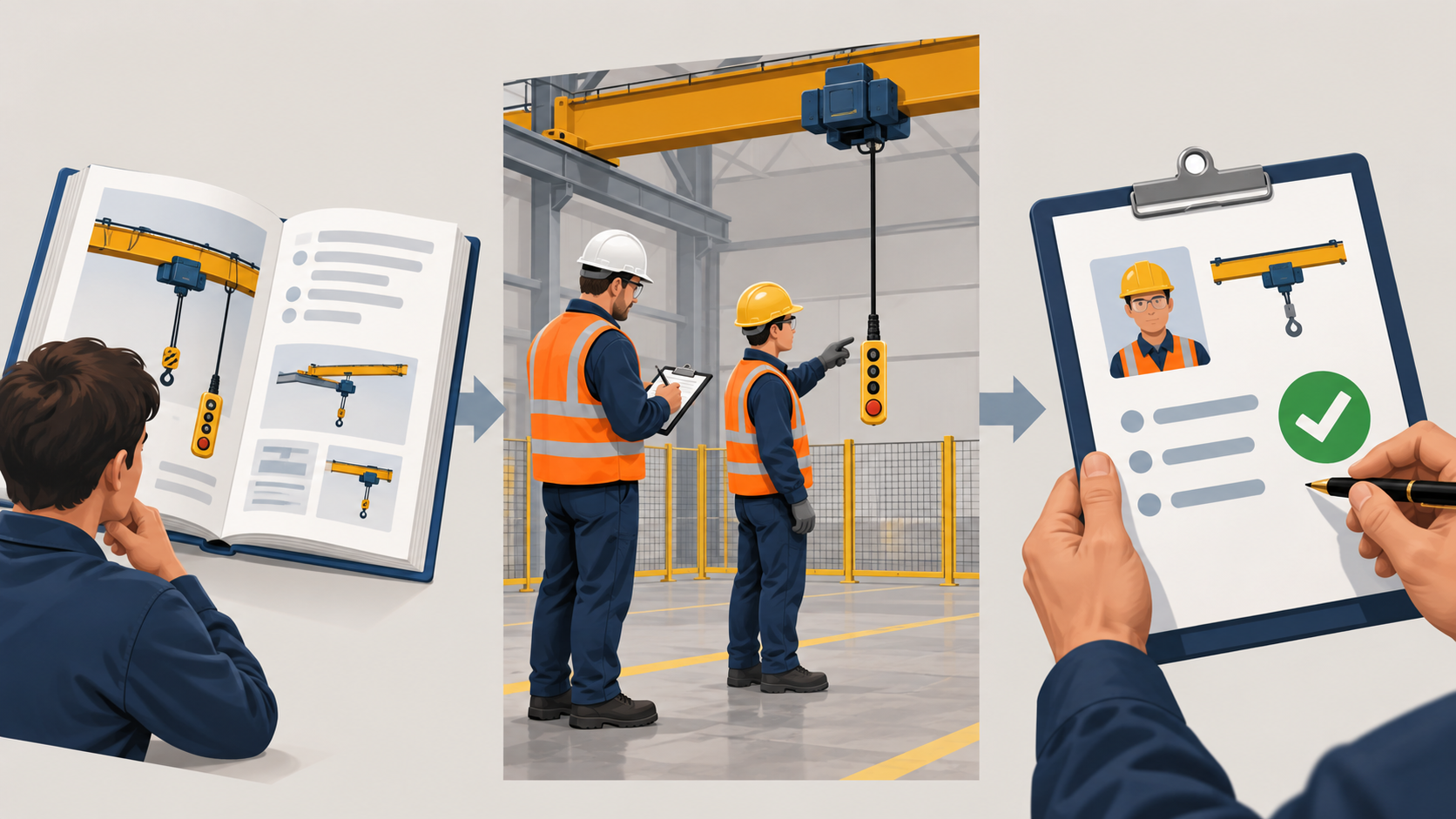
A short pre-job briefing supplements existing qualification and instruction; it replaces neither. The responsible person asks the team to describe the load, intended route, landing area, roles and communication arrangements. Unclear load information, unresolved equipment suitability or an unsecured working area are not details to complete afterwards. Resolve them before starting. This guide recommends a compact briefing structure, not a universal statutory approval checklist for every lifting operation.
Discuss interfaces as well: who might enter the area, which contractor is working nearby, and what other activities could affect visibility or communication? Adjacent welding may require additional coordination. Our article on welding fumes and protective measures addresses that separate hazard; a crane briefing does not replace instruction about it. Ask participants to explain how they will stop when conditions change, inform the responsible person and establish conditions for safe resumption. Keep unresolved issues explicitly open.
 AI-generated
Three cases for a team discussion
Case one: the new employee has passed an online assessment but has no evidenced practical qualification for slinging. A delivery deadline is approaching. The correct organisational decision is not to assign independent slinging work. A suitable responsible person arranges qualification, practical assessment and subsequent familiarisation. The team rehearses the decision using the scenario, rather than improvising dangerously around a load. The planned task remains with someone appropriately qualified and authorised.
Case two: an experienced crane operator transfers from another hall. His records are available, but the controls differ. The supervisor establishes which competence is already evidenced and what familiarisation or additional qualification the new assignment requires. Only after resolving this is the assignment defined appropriately. Such a transfer is neither automatically a complete retraining exercise nor merely an administrative change. The technical gap determines the next steps and the evidence to retain.
Case three: a qualified slinger notices before starting that the marking on a proposed lifting accessory cannot be read reliably. The discussion should not ask whether she can estimate its capacity from experience. Ask how she prevents its use, reports the defect and obtains competent clarification. Work can proceed only with suitable, clearly identified equipment and resolved conditions. A course certificate does not cancel a specific equipment defect.
Different records must answer different questions
Keep attendance, learning results, demonstrated practical competence, familiarisation and assignment distinguishable in your records. Attendance shows who participated in a learning activity. A documented practical assessment instead describes the tasks, observed performance, limitations and assessor. Authorisation identifies the assigned scope of work. Even when stored in one system, these remain separate facts. A single column marked trained conceals precisely the gaps that supervisors need to recognise before allocating a shift.
For the use of work equipment, section 12 BetrSichV requires further instruction at regular intervals, at least annually, with the date and participants' names recorded in writing. This is a specific legal requirement, not a blanket claim that every course must be repeated annually. Changes to duties, equipment and hazards also matter. Establish both a planned instruction cycle and a route for reviewing changes. An automated reminder cannot detect a changed working method by itself.
Review the three scenarios by checking whether responsible people recognise the same boundary and identify the correct next action. If several people list risks but nobody owns the authorisation decision, the problem is organisational. If ownership is clear but the team cannot explain the agreed procedure, targeted follow-up is needed. Revisit that specific decision afterwards. Record not only attendance but also outstanding actions, their owners and verification that they were completed.
Prepare digitally, decide operationally
Digital content can introduce terminology, responsibilities and typical decisions, and refresh knowledge. Its operational value depends on connecting it to suitable practical qualification, workplace-specific familiarisation and explicit authorisation. ConformBase's steel package lists a course about cranes, loads and slingers. At the editorial check on 27 October 2026, the offer still described content review and registration of interest. This does not establish immediate course availability, a recognised practical qualification or automatic permission to operate a crane.
Start with one manageable shift and a clearly bounded set of duties. Review existing evidence, flag gaps and identify who will resolve technical questions. Test the decision process against an absence, an equipment change and a reported defect. Extend it to other areas only when the responsible people apply the same boundaries consistently. The goal is not the greenest possible dashboard, but a reliable answer to who may perform which task under which conditions.
ConformBase
Turn knowledge into training that works.
Bring compliance, privacy and security awareness into a format your people want to complete, with certificates and audit-ready evidence.
Start free trialAsk about custom courses →