
Welding fume training: make decisions at the workstation, not just repeat rules
In a steel operation, welding fume does not become relevant only when a measurement attracts attention or someone reports symptoms. Prevention starts before the first arc: with the process and material, preparation of the work area, capture, and the question of who may stop work. Effective instruction translates those points into observable decisions. People do not need to memorise all hazardous-substance rules. Before work begins, they need to recognise whether agreed controls are present, whether a deviation exists, and which query or escalation follows. That ability can be trained in short exercises close to the real workstation.
For German operations, risk assessment is the starting point. Section 6 of the German Hazardous Substances Ordinance on risk assessment requires employers to identify and assess hazards from activities involving hazardous substances. For a welding job, this means a general leaflet does not decide protection. The relevant combination is the process, filler material, coating, work location, duration, ventilation, and people involved. Instruction explains the resulting operational requirements in understandable language. It replaces neither assessment of the case nor any necessary measurement or competent specialist advice.
Derive instruction from the actual job
Dependable preparation separates three levels. Competent specialists describe the hazard and planned technical, organisational, and personal controls. Managers decide who prepares the area, checks it, and decides on deviations. Workers practise the few situations they must judge themselves. The occupational safety foundation course helps order these roles. In welding, process, location, and release point must fit. A general safety talk with no connection to the next task leaves those handoffs open.
Use a real job as the learning case. What is being welded, where is the work taking place, how is the area separated from other activities, which capture is planned, and who issued the release? For coated or alloyed materials, those details belong visibly in the case. Online occupational safety instruction and documentation is useful background on connecting learning with operations. It does not free anyone from involving the competent person for the actual task. Good instruction shows the boundary between observing, reporting, and deciding as a specialist.
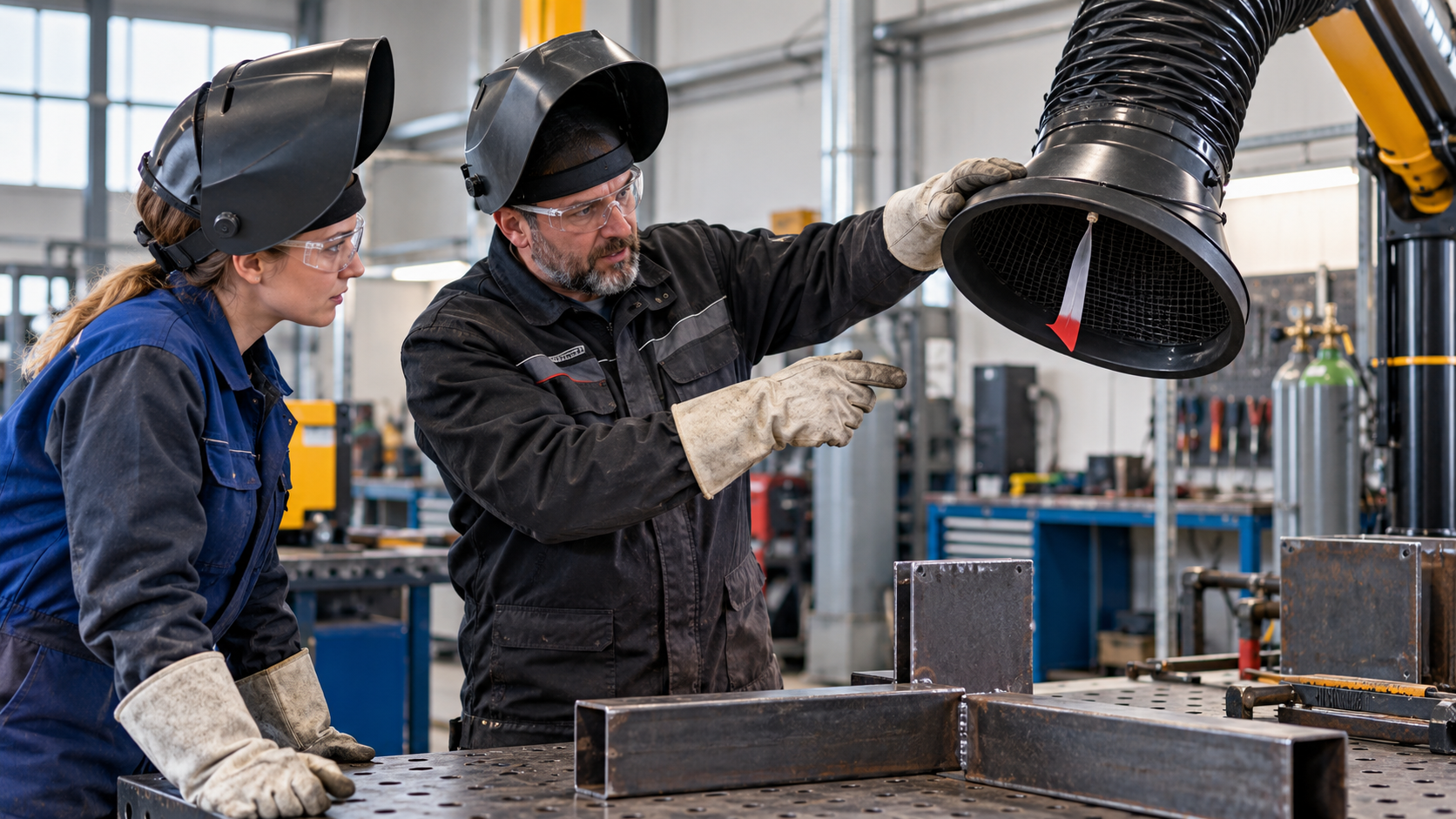
A start card with five questions is often enough for the first check: are job, material, and location clear; is the planned capture present and positioned correctly; is the work area prepared and protected from other people; is required personal protective equipment available; and is it clear whom the worker contacts when something deviates? This card is not a substitute for operating instructions. It makes the start check repeatable and gives management concrete points to observe during an effectiveness review.
 AI-generated
Explain controls in the correct order
For welding fume, the order of controls matters. TRGS 528 on welding work is an important German technical rule for operational planning. Training should not turn it into a seemingly complete short version. The clear message is: first check whether hazardous substances or exposure can be avoided or reduced. Then come technical capture and ventilation, safe organisation, and only then supplementary personal protective equipment. This avoids the false impression that personal equipment can freely replace a missing or ineffective engineering control.
Workers do not need to design extraction, but they need a usable picture of what to check. Capture should work where the fume plume is created, not merely run somewhere in the room. A displaced hood, damaged hose, switched-off unit, or work in a confined area are not small details. In practice, this becomes a clear sequence: do not start or safely stop, name the deviation, inform the responsible person, and continue only after a clarified release. This language is more precise than a generic “be careful when welding.”
Personal protective equipment belongs in instruction, but not as an alibi for missing engineering controls. When respiratory or other equipment is planned for a specific case, people need to understand what is provided, how it is used, and where its limit lies. They must not conclude that they can simply continue with extra equipment when capture is switched off or visibly ineffective. The crisis-team tabletop exercise provides a transferable method for practising a stop decision, named escalation, and documented next action under realistic pressure.
Short case exercises instead of a long lecture
A welding-fume briefing can begin with three scenes. In scene one, the capture hood is too far away. In scene two, the material differs from work preparation and its coating is unclear. In scene three, building conditions change the airflow. Each group answers the same questions: what do I observe, what may I not decide alone, whom do I inform, and what must be clarified before start or continuation? The learning benefit is not a perfect remote judgement. It is making an uncertainty visible early and precisely.
The legal duty to instruct remains embedded in the rules. Section 14 of the German Hazardous Substances Ordinance on operating instructions and instruction requires verbal instruction before work begins and at least annually thereafter under the conditions set out there. Date and attendance alone, however, do not show that instruction matched the workplace. Mandatory employee training in 2026 reconnects cadence, role, learning aim, and evidence.
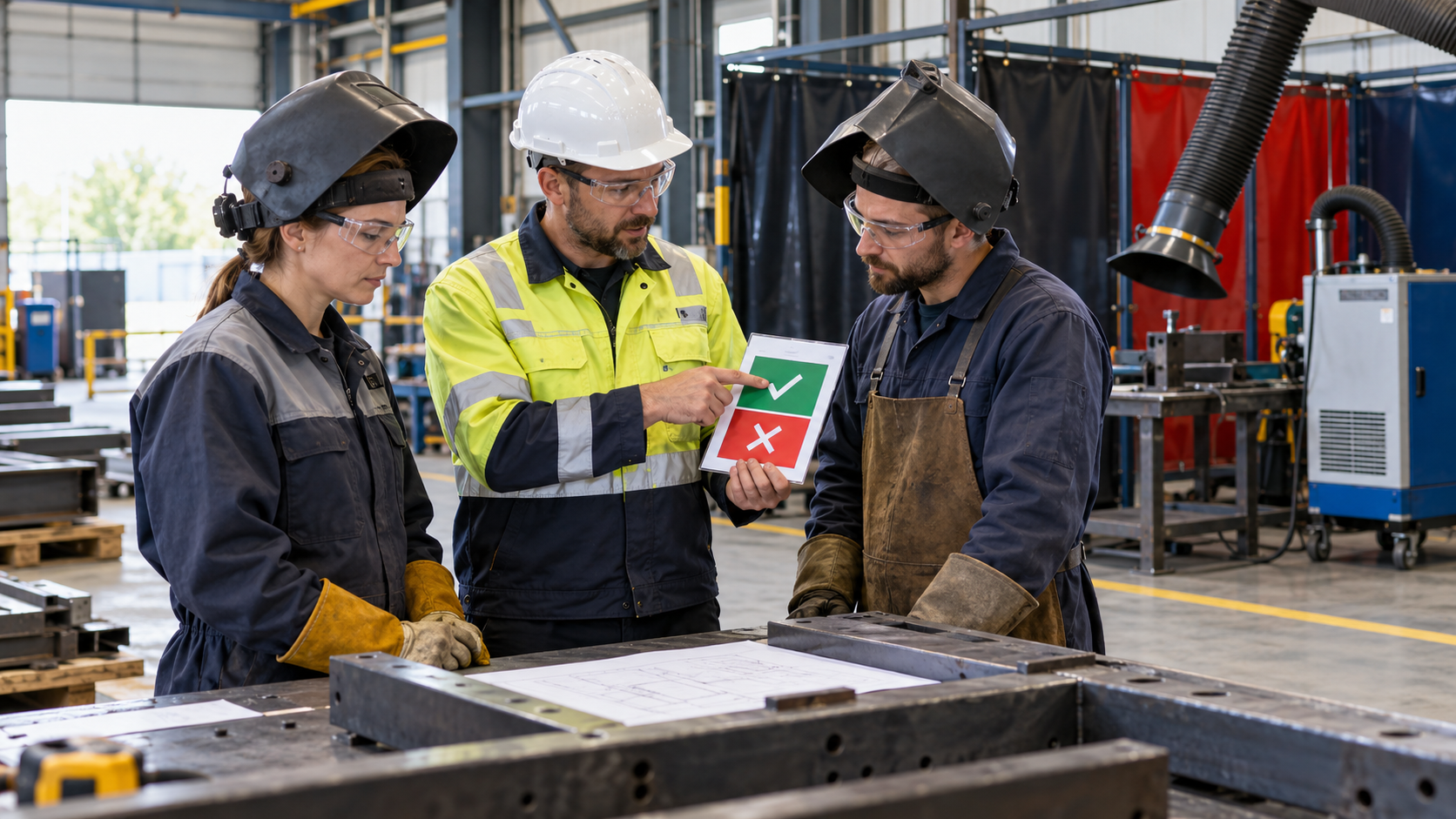
Short exercises are strong when they lead to a decision. Ask a team to check capture before a simulated start, state a deviation in one sentence, and record the response from the responsible person. Afterwards, management should discuss more than the correct answer: was it clear who could decide, was work stopped safely, and was the next step findable? The role-based training matrix offers a transferable way to make assignments and evidence visible, but it does not replace workplace-specific welding-fume practice.
 AI-generated
Keep evidence and feed findings back
Dependable evidence records more than names and a date. Document the target group and work area, learning objectives, start and stop criteria covered, operating instruction used, exercise or knowledge check, questions, and the person responsible for follow-up. Audit-ready training records without spreadsheets helps turn scattered lists into a findable chain of assignment, delivery, result, and open action. It does not replace any statutory retention requirement for a specific case.
Connect instruction with an improvement loop. If several exercises leave people unsure where capture belongs, whether material is released, or whom to call during a fault, this can point to a gap in preparation, labelling, equipment, or management rules. A deputy matrix for key personnel offers a transferable pattern for making decisions and contacts available when the usual owner is absent. Feed findings back into risk assessment and operational prevention.
Finally, plan a short effectiveness check that suits the operation. During the next job, a manager can observe whether the start check happens, whether capture is checked before work, and whether workers raise a deviation without hesitation. Add a competent inspection of the technical installation where needed. Separation of roles is decisive: instruction teaches behaviour and reporting routes, while specialists assess the hazard and suitability of controls. This turns a mandatory appointment into a repeatable safety routine.
See the workstation as a system
Welding-fume protection often fails not because of one obviously wrong action, but at an interface. Work preparation does not know the material precisely. Extraction was not realigned after a change. A contractor works in the area at the same time. Or a deputy cannot find the release. Put such handoffs into instruction. Ask workers to name which information is missing, where they can find it reliably, and who must decide. This trains not only behaviour at the equipment, but also safe cooperation among planning, maintenance, management, and execution.
A useful exercise distinguishes a fault that is immediately visible from an uncertainty that emerges only by asking questions. A capture unit that is not running is visible. A changed coating, moved work location, or an additional person in the area may be less obvious. Both deserve a clear report, but they can trigger different specialist checks. To keep instruction from becoming vague, define in advance who receives the report, how it is recorded, and which response the worker expects before continuing. A stop rule works only when the route back is equally dependable.
Shift handover also deserves a short learning point. Open releases, technical faults, and pending queries should not be passed on only verbally. Set a findable status: what has already been checked, what is prohibited, who is handling the open question, and when the case will be reviewed again. With changing teams, this simple transparency reduces the temptation to make assumptions under time pressure. Managers can sample the quality of handover and carry recurring gaps into the next instruction. This connects a single learning event with real operational control.
Sources and limits
This article is an organisational and learning guide for German steel operations. It makes no measurement, release, or legal decision for an individual workplace. For a specific job, consult the risk assessment, operating instruction, relevant technical rules, and competent specialists. When process, material, workplace, or capture changes, check whether the existing assessment and instruction still fit.
- German Hazardous Substances Ordinance, Section 6 risk assessment
- German Hazardous Substances Ordinance, Section 14 operating instructions and training
- BAuA: TRGS 528 welding work
Manage instruction and evidence for steel teams in a structured way
ConformBase
Turn knowledge into training that works.
Bring compliance, privacy and security awareness into a format your people want to complete, with certificates and audit-ready evidence.
Start free trialAsk about custom courses →