Lone working instruction: a disruption on the late shift
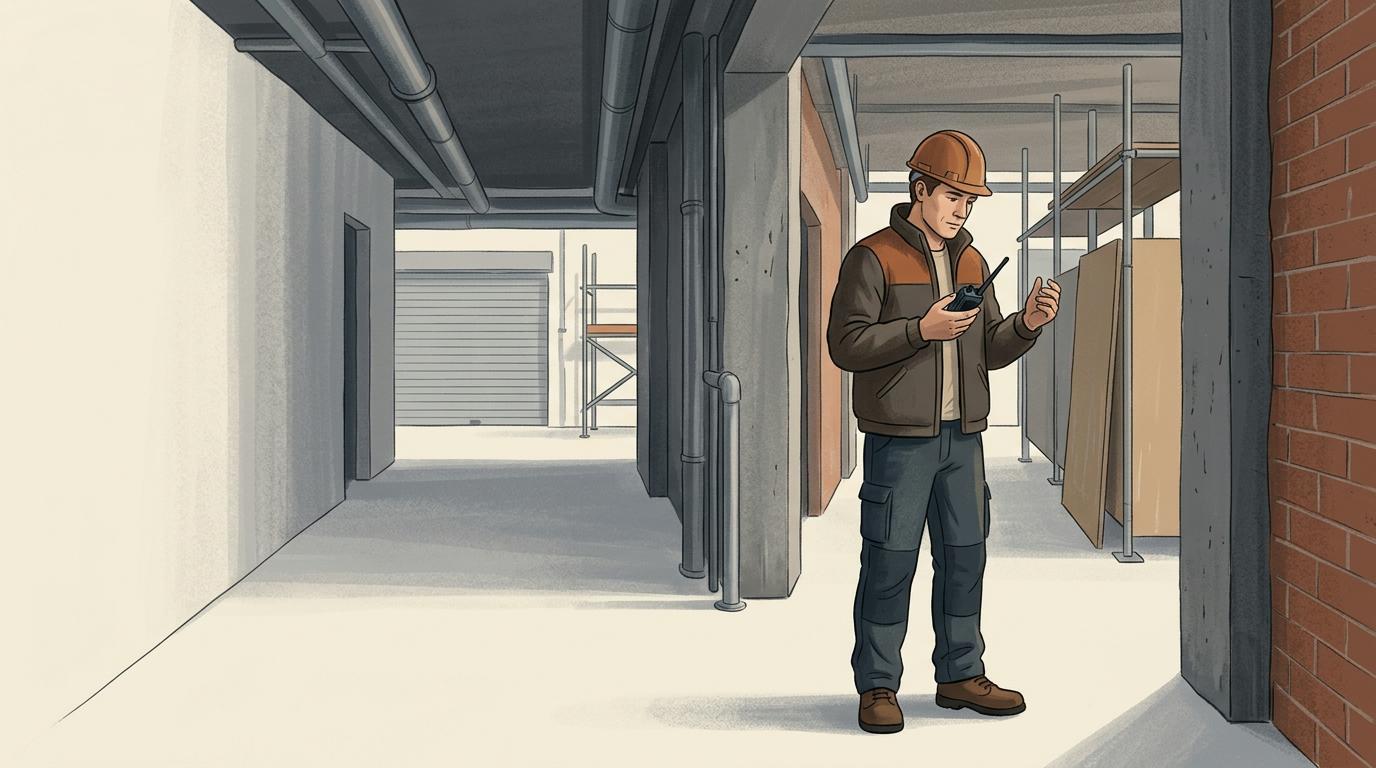
In a fictional late shift, Lea checks a building area on her own. Her workplace radio fails during the round; shortly afterwards she notices an equipment fault. Lone working instruction should do more than give her a telephone number. She needs to know when to stop safely, which protected route to use and who will notice a missed check-in. This fictional case is a training example for workplaces in Germany.
Lea's actual permitted steps depend on local safeguards and responsibilities, not on this example. Training does not make unsuitable working conditions safe. The supervisor must first determine whether the task can be carried out alone under the actual conditions and which additional rules apply.
Assess the risks before instruction
The responsible supervisor and occupational safety specialist describe the task, location, time and possible disruptions. Under section 5 of the German Occupational Safety and Health Act, the employer determines necessary protective measures by assessing work-related risks. In Lea's case this includes how help can reach her if she cannot call herself. The DGUV guidance on emergency calls explains selection in the context of risk assessment.
Reception gaps, locked access routes, hazardous substances and medical emergencies call for different measures. A contact list alone does not solve each problem. Section 8(2) of DGUV Regulation 1 provides for suitable additional technical or organisational measures for hazardous lone work. Check the applicable rules to determine whether the specific task must not be performed alone or requires particular safeguards.
Define Lea's reporting chain before the shift
The shift lead names an available contact and a backup. Both need to understand their roles and actually be reachable during the agreed period. The procedure states when Lea checks in, who receives the report and what the contact does if a check-in is missed. Intervals and escalation steps are local decisions based on the risk assessment, not universal statutory minute values.
Lea reports her precise location, task and any change of plan. The receiving person confirms what they understood. At shift handover, ongoing work, the latest check-in and open issues are passed on. The article on shift-work safety instruction explores handovers and participation in more detail.
What Lea should decide during a disruption or emergency
If the radio fails, Lea does not simply continue under unchanged conditions. In the exercise she safely stops the affected task, moves to a safe place by the approved route and uses the previously agreed backup reporting method. If that also fails, the site's stop and escalation procedure applies. Instruction must identify that procedure; it must not require an unsafe journey to find reception.
In an acute emergency Lea alerts the designated contact or emergency services under local arrangements where she can do so safely. Personal safety and directing responding help belong in the emergency plan. Section 10 of the German Occupational Safety and Health Act requires the employer to take necessary first-aid, firefighting and evacuation measures and arrange external contacts. The employer must separately designate who may release equipment for use; Lea does not attempt a repair on her own.
A reporting sheet to adapt
Before each shift the supervisor can review a short sheet with Lea and the contact. This is a practical suggestion, not a statutory template. Telephone numbers and authorisations must be checked locally; sensitive information belongs in the designated systems.
- Task, precise location and planned period;
- Contact, backup and confirmed availability;
- Agreed check-in times and meaning of a missed check-in;
- Primary and tested backup reporting method, including a safe location;
- Stop criteria, escalation and access for responders;
- Open issues, responsible person and handover to the next shift.
After a missed check-in the contact follows the agreed procedure and records the next steps. They must not send an unprepared searcher into a hazardous area. The article on maintenance and handover explains why responsibility and authorisation should be defined separately.
Three roles and one safe rehearsal
The instructor facilitates, Lea plays the lone worker and a third person acts as contact and observer. A card represents the radio failure; no equipment is actually switched off and no one enters a hazardous area. Lea first reports her location. She then receives the disruption card and describes her next safe step. Finally, a planned check-in is missed in the scenario and the contact explains the escalation.
Four observable outcomes support review: Lea recognises the failure, stops safely, identifies a permitted backup method and reports location and situation; the contact also explains the response to a missed check-in. If unsure, the instructor explains the procedure again and asks for a repeat. These criteria are a practical learning aid, not a statutory scoring system. The practical exercise guide offers further ways to simulate safely.
Track instruction and unresolved defects separately
Section 12 of the German Occupational Safety and Health Act requires sufficient and appropriate instruction during working hours, tailored to the workplace or duties. It takes place before work begins on recruitment and certain changes, is adapted to changing risks and repeated regularly where necessary. Check the applicable rules for additional repetition and documentation duties.
The supervisor keeps a traceable record of topic, date, participants, exercise result and agreed follow-up. A training record does not fix poor radio reception: record it as a separate action with an owner, target date and effectiveness check. Workplace restrictions remain in place until a suitable solution is available. The article on learning checks explains how to assess questions and practical decisions.
Finish with the actual workplace
Finally, ask Lea to explain the location, contact, backup method and response to a missed check-in in her own words. Then check that the contact is reachable and that the emergency chain can actually work. ConformBase course previews help select digital foundations; supplement them with your risk assessment, local rules and practical exercise. A course replaces neither safeguards nor a functioning emergency plan.
Official sources
ConformBase
Turn knowledge into training that works.
Bring compliance, privacy and security awareness into a format your people want to complete, with certificates and audit-ready evidence.
Start free trialAsk about custom courses →Won through a public tender: AI literacy for DIW Berlin, from kick‑off to sign‑off in one month.