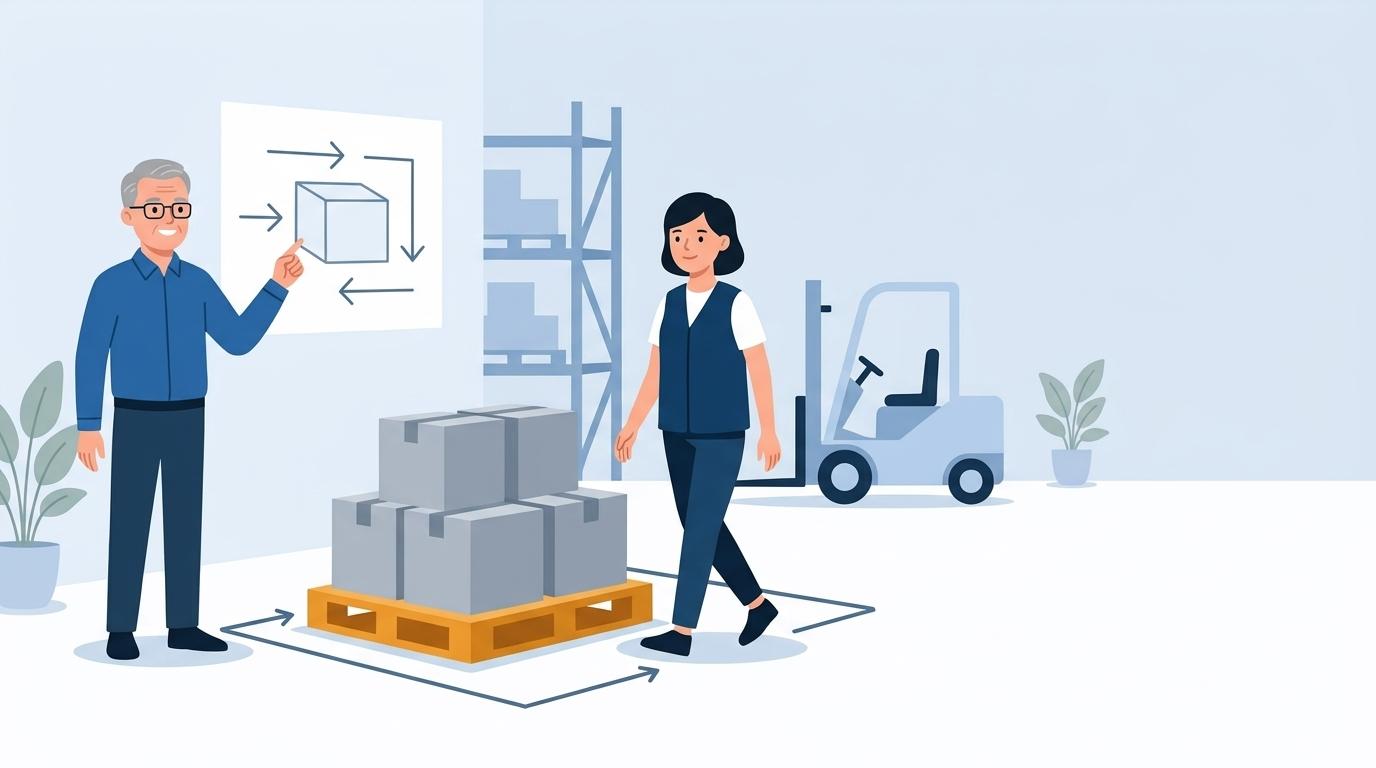
A pallet blocks a traffic route in a warehouse. An employee knows the rule from training but would still walk between the pallet and a forklift. An assessment should reveal precisely that decision: recognise the hazard, keep a safe distance and use the designated reporting route. The goal is not to ask as many questions as possible, but to match tasks to actual work.
Safety training assessment: From learning objective to task
Start with the risk assessment, workplace instructions and the actual task. Then describe what employees should recognise, decide or perform safely before choosing an assessment method. Section 12(1) of the German Occupational Safety and Health Act requires adequate and appropriate instruction tailored to the workplace or role. It does not prescribe a particular test or universal passing score for every training session.
- Identify the task and risk: where could a wrong decision cause harm?
- Define the objective: what exactly should the person do in that situation?
- Select evidence: is a reasoned answer enough, or must an action be observed?
- Prepare criteria and feedback: what must be observable, and how will gaps be addressed?
Choose questions that test decisions
A useful question describes a realistic situation and asks for a decision and its reasoning. Avoid trick questions and options that give away the answer through their wording. Use clear language and offer an opportunity to ask for clarification. Open questions reveal reasoning; carefully designed multiple-choice questions help compare responses.
- Warehouse: “A traffic route is blocked and a forklift is approaching. What do you do first?” Look for staying out of the danger zone, keeping a safe distance and using the workplace reporting route.
- Office: “You notice a damaged power cable. What do you do?” Look for stopping use of the affected equipment and reporting the defect under local rules rather than attempting a repair.
- Fire safety: “Your designated escape route is blocked. How do you find an alternative?” The answer must match the actual evacuation plan.
Choose and observe practical exercises safely
When the objective involves a physical action, orientation on site or a sequence of steps, add a practical exercise. Practise under supervision in a safe environment without creating a real hazard. For example, simulate a report rather than triggering an actual alarm. Higher-risk activities remain subject to workplace safeguards and any additional requirements; a short exercise does not replace required qualifications or authorisation.
- Traffic routes: use a map or cordoned-off area to have the participant identify safe routes and conflict points; check hazard recognition and knowledge of the reporting route.
- Escape routes: walk an approved route together using the current plan; check orientation and the assembly point against local arrangements.
- Defect reporting: describe a prepared scenario with no electrical hazard and simulate the report; check whether the person would stop using the equipment and whom they would inform.
Assess, follow up and observe effectiveness
Decide in advance which safety-critical steps must be demonstrated. A score alone can conceal a missing critical safeguard. Discuss the result promptly and constructively. If someone is unsure, explain the step again, practise it safely and check it once more. If gaps remain, agree next steps with the responsible manager; do not leave anyone alone with an unresolved hazard.
For workplace follow-up, record the topic, task, date, participants, assessment method, outcome and agreed actions in line with your organisation’s rules. Limit personal information to what is necessary and follow your data-protection rules. Later, observe whether the agreed measures are actually applied at work. Results may also reveal unclear instructions or an unsuitable workflow.
Official sources
ConformBase
Turn knowledge into training that works.
Bring compliance, privacy and security awareness into a format your people want to complete, with certificates and audit-ready evidence.
Start free trialAsk about custom courses →