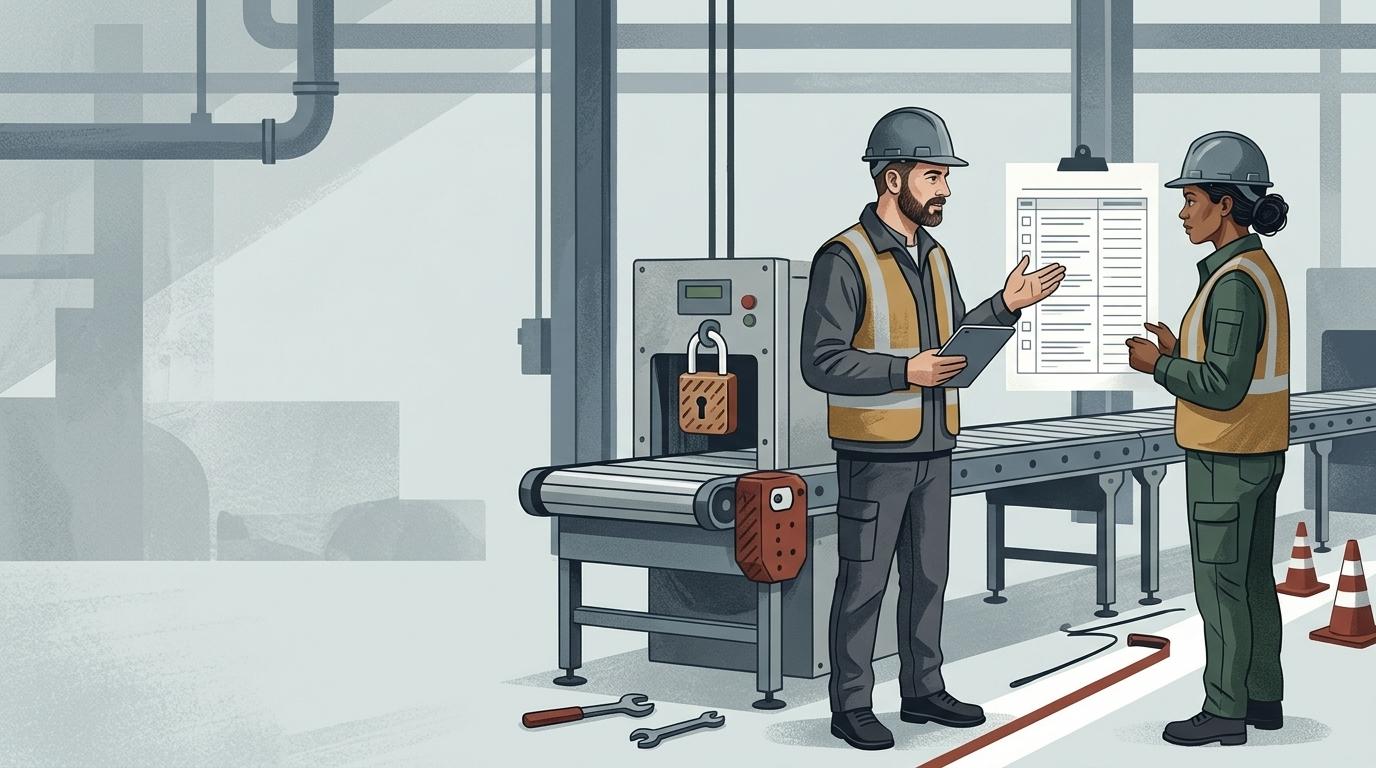
Maintenance training: a job under time pressure
A conveyor has stopped. Shift supervisor Lena expects a maintenance team to replace a component, while production wants to restart quickly. A stationary machine alone does not establish that all energy sources are safely controlled. Lena and the team discuss what is handed over, which safeguards the local procedure requires them to check and who authorises the start. The scenario is fictional; decisions must be made locally using the risk assessment.
Course completion is not permission to work. A signature does not prove that equipment is technically safe. The contractor coordination guide explores the interface with outside teams; separating decisions also helps Lena with internal maintenance.
Clarify the job and roles before handover
Lena identifies the machine, work area and component replacement. The maintenance lead explains the method and reports hazards from the work. Together they consider adjacent activities and agree who is reachable. A name on a form does not confer competence or authority. Local arrangements must establish who assesses equipment condition, leads the work and decides on acceptance.
Where several employers are involved, section 8 of the German Occupational Safety and Health Act requires cooperation on safety and health. Coordination depends on activities and risks. Lena compares the site's information with the contractor's rather than relying solely on general induction at the gate.
Instruct at the actual work area
Lena discusses access, adjacent equipment, emergency and reporting routes and job boundaries. Responsible specialists explain safeguards and evidence. A team member explains back where work is permitted and whom to contact if conditions change. An unresolved safety issue is resolved before the start. This is not an instruction to perform technical isolation without competence.
Section 12 ArbSchG requires adequate and appropriate instruction related to the workplace or task, adapted as risks develop and repeated regularly where necessary. When equipment changes, the guide to instruction on new work equipment helps. The actual equipment state still needs a separate check.
Handover record: eight fields for a clear decision
Lena uses a local record as an organisational aid, not as a universal statutory form. A job reference connects the information. Each open item has an owner and next step. Specialist procedures and technical evidence are referenced rather than replaced by a checked box.
- Job reference, equipment and physical boundary.
- Task and excluded work.
- Participants, responsible roles and reachable deputies.
- Hazards, interactions and information sources.
- Safeguards, owners and verifiable evidence.
- Start decision, authorised person and conditions.
- Changes, interruptions and reassessment.
- Progress, outstanding items, return and operational acceptance.
Approval before starting: check more than the form
The authorised role assesses whether job, safeguards and prerequisites match local procedures. Section 10 of the German Industrial Safety Ordinance addresses safe maintenance of work equipment, including dangerous energy and coordination. Competent, authorised specialists determine the technical measures for the equipment. Lena records the decision basis. If a prerequisite is missing, the affected work does not begin; she identifies the person responsible for resolving it.
Change and shift handover: stop and reassess
During the work the team notices another component requiring attention. Replacement was outside the approved scope. The team does not expand the job on its own; it suspends the affected activity and informs Lena and the maintenance lead. They establish whether the risk assessment, safeguards, participants or approval need revision. Another trade starting nearby can trigger renewed coordination.
At shift change Lena hands over progress, hazards, safeguards in place and outstanding decisions to an authorised deputy. The receiving person explains the situation back and confirms the next step. If nobody with the required authority is available, time pressure does not replace a decision. The job status remains traceable.
Exercise: three roles and four observable results
In a tabletop exercise, three participants act as operations, maintenance and observer. Start with Lena's conveyor, then introduce an additional task nearby. The team completes the handover record, explains its start decision and responds to the change. The observer checks four outcomes: Is the scope clear? Are safeguards linked to owners and evidence? Is the change recognised as a reason to stop? Can the reporting route and deputy be explained?
If an outcome is missing, the group repeats that step with feedback rather than merely signing an attendance list. Choosing practical exercises helps adapt the exercise to different tasks. A tabletop exercise does not replace required practical competence or equipment-specific instruction.
Separate return from restart
After maintenance, the team reports completed work and remaining issues. Responsible specialists check removal of safeguards under the procedure; the authorised operational role decides on acceptance and, where appropriate, restart. A completion notice alone is not automatic permission to restart. A review records missing handover information and improvements for the next instruction.
Digital learning can prepare shared terminology and scenario decisions. ConformBase course previews help teams select learning material; site-specific instruction, practical competence and actual work approval remain separate tasks.
ConformBase
Turn knowledge into training that works.
Bring compliance, privacy and security awareness into a format your people want to complete, with certificates and audit-ready evidence.
Start free trialAsk about custom courses →