
From a signed plan to observable practice
A new employee knows the hygiene plan and passes the final quiz. Then the telephone rings while she is working in a treatment room wearing used gloves. This transition reveals whether knowledge survives everyday interruptions. Healthcare hygiene training should therefore rehearse interruptions, changes of equipment and unclear responsibilities, not merely test terminology. This guide is for people responsible for training in German medical practices, hospitals and care facilities. It proposes a local exercise design, not a universal clinical protocol. Approved facility procedures, the specific risk assessment and necessary practical instruction remain authoritative. The intended outcome is a team that recognises critical transitions and can demonstrate the approved safe response under realistic time pressure.
Start with a manageable pilot area, such as two treatment rooms and their reception desk. Management appoints a subject-matter owner, a deputy and someone with authority to correct organisational defects. Nursing, clinical support and cleaning staff jointly describe three common workflows. This creates a testable connection between a task and its protective measures instead of an abstract organisation-wide programme. The healthcare topic collection can provide general learning components, but course completion replaces neither the local hygiene plan nor authorisation for specific work. Before use, compare the course content with each role and the actual local workflow. New employees particularly need a named person to consult during their first practical applications.
Separate legal scope from local ownership
The actual type of facility matters more than the broad label healthcare. Section 23 IfSG addresses infection prevention in medical facilities and identifies facilities requiring hygiene plans; state-level rules may also apply. Care facilities and care businesses require a separate assessment under section 35 IfSG. The responsible specialist should therefore record the facility type, applicable requirements and approved plan version. These provisions do not mean that every person must complete an identical standard course. Nor does an arbitrary attendance certificate establish that local protective measures are suitable. What matters is a defensible implementation of the requirements that actually apply to the facility and its working conditions.
Worker protection must also be addressed. Within its applicable scope, section 14 BioStoffV requires oral instruction based on the current operating instruction, before work begins and at least annually thereafter, in an understandable and workplace-specific form. Content and timing must be recorded in writing and acknowledged by signature. The current TRBA 250 specifies healthcare requirements and also identifies significant changes in working conditions as an instruction trigger. This is more precise than claiming that every hygiene course has the same universal statutory annual deadline. An online occupational safety instruction concept should distinguish digital preparation, oral discussion and practical checking. An automated quiz completion record alone does not fully demonstrate these requirements.
Translate each plan requirement into a decision
Prepare a simple exercise card with seven fields: location, specific task, trigger, required action, necessary materials, escalation contact and observable outcome. Add the relevant passage in the local plan, its version and specialist approval. One card might describe moving from contact with a patient to operating shared equipment. The expected answer must come from the approved workflow, not an individual colleague’s memory. If two documents give conflicting instructions, resolve that conflict first. Training must not replace an unresolved procedural decision with a vote among participants. This is particularly important at time-critical transitions, where uncertainty is easily concealed by a familiar but unverified routine.
Keep the role matrix small and action-focused. Reception staff practise communicating an observation and handling shared touchpoints within their responsibilities. Clinical and nursing staff rehearse the relevant task changes at the point of care. Cleaning staff practise defined room handovers, material separation and clarification when status is uncertain. Managers practise resolving reported supply shortages and organising a documented return to the normal workflow. Link a separate learning path for patient data in everyday work instead of embedding confidential information in hygiene exercises. Include contractors and temporary cover in the allocation. The decisive factor is the task and its risk, rather than whether someone belongs to a particular employment category.
Exercise 1: Hand hygiene during an interruption
Run the first simulation without patient contact and without contaminated material. One participant describes a normal workflow, a second introduces a realistic additional task and a third observes. The group identifies where the local plan requires hand disinfection, a glove change or another measure. The KRINKO hand hygiene recommendation provides a professional foundation; product selection, application conditions and additional measures are checked against current approved local procedures. Do not rehearse a memorised sequence detached from its indication. The participant should explain the transmission risk at the transition and why the next action addresses it. Suitably qualified personnel lead the practical instruction rather than leaving participants to invent their own clinical technique.
A useful case is moving from a simulated contaminated task to a telephone or keyboard. The observer checks whether the participant recognises the transition in time, rather than merely naming the correct concept afterwards. Gloves do not replace required hand disinfection. TRBA 250 identifies hand disinfection after removing protective gloves before leaving the work area, among other indications. Afterwards, discuss why the interruption created a problem and which organisational alternative could prevent it. Another person might answer the telephone, or the communication arrangement may need to change. A valid result can therefore be a better work design, not merely a request for staff to pay more attention.
 AI-generated
Exercise 2: Hand over an uncertain room status safely
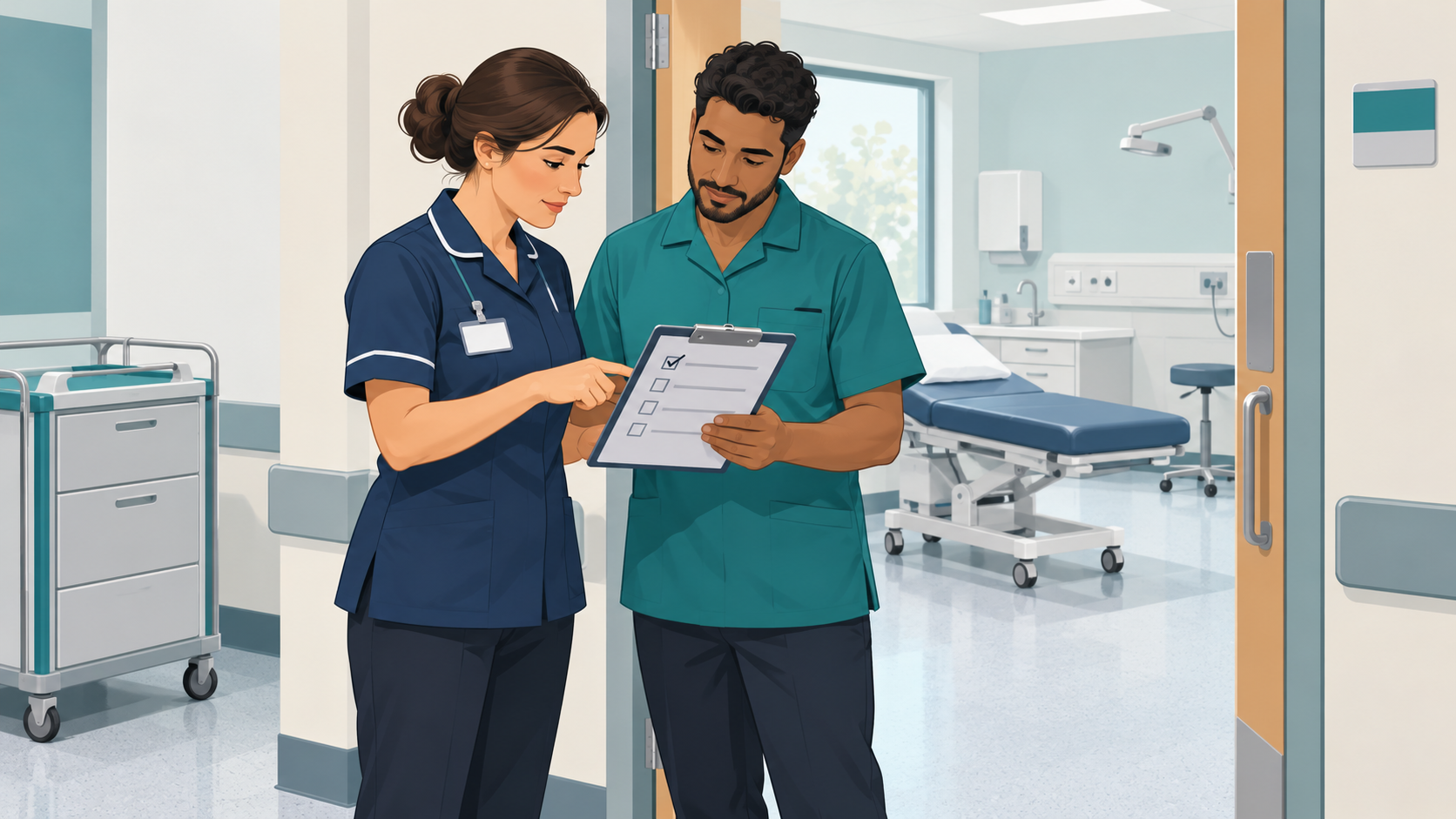
For the second case, use only clean demonstration materials on a training table. Give the group a fictional handover: a room is due to return to service, but information about required cleaning and disinfection is missing. The task is not to judge whether the room looks clean. It is to establish its status through the local procedure without asserting unsupported clearance in the meantime. Participants show where the information belongs, who confirms it and how the next colleague receives it. This creates an explicit interface between clinical work, cleaning and coordination. Silence is not a substitute for the agreed handover, even when the next person is already waiting.
Add a change to the case: the specified material is unavailable, or product information conflicts with the plan. The appropriate learning response is to consult the responsible specialist, not improvise a mixture or invent a contact time. The exercise card records who interrupts the affected process, who can approve a safe alternative and who documents the decision. The Hygiene and Infection Prevention course can prepare terminology, but it does not determine local products or patient-specific additional measures. Also test whether the necessary information is accessible on late and weekend shifts. A process that works only when one particular person is present is not yet reliably organised.
 AI-generated
Exercise 3: Escalate observations without inventing authority
In the third case, an employee notices that a required protective measure repeatedly cannot be implemented. She practises a short internal report covering location, time, observation, any immediate protective action and a contact for follow-up. Assumptions are identified as assumptions. Clinical assessment, patient-specific decisions and statutory notifications remain with the responsible persons. An internal observation report is not automatically a notification to the public health authority. The local plan must explain these transitions. Ask the receiving role to repeat the information and identify the next step. This reveals whether the message has actually been received and understood or merely disappeared into a general inbox.
Use fictional names and minimal information in these scenarios. Patient confidentiality still applies when a real incident would make an interesting teaching example. A case discussion usually does not need an identifiable patient history. If an actual incident requires a separate review, access, storage and ownership belong in the designated incident process. The training record instead documents the action practised and whether the participant could apply it convincingly. Sensitive information about employees’ health also does not belong in openly accessible attendance lists. Separate learning administration, occupational medical advice and incident records so that useful evidence does not create unnecessary privacy problems. This also makes subsequent evaluation more focused.
Check learning and evidence separately, but connect them
Assess the exercise against a few clear observations: recognising the critical transition, finding the approved instruction, demonstrating the required action, naming the correct owner and raising uncertainty promptly. An internal traffic-light scale can help, but it is not a statutory assessment scheme. A participant who cannot safely demonstrate an essential step receives targeted coaching and repeats that case. A high average score on unrelated quiz questions does not cancel the gap. Observers should first calibrate the criteria together using one example. Otherwise, morning and evening shifts may assess different things. New products, rooms or duties trigger a review of the affected exercise cards and practical support needs.
Reliable training records connect the person and role with the date, plan version, content, instructor and outcome. Also capture open corrective actions, their owners and agreed follow-up checks. Where a statutory signature requirement applies, the chosen documentation must meet it; an arbitrary platform status is not a blanket assurance. An audit export is only as informative as its underlying data. Inspect a specific record to confirm that the actual exercise and its specialist approval can be retrieved. Determine access and retention under the applicable rules and local policy instead of inventing a universal retention period. A record should evidence instruction that actually happened, not serve as its retrospective substitute.
Evaluate the pilot and improve the plan
After the first round, hold a short review involving every participating role. Which point was repeatedly misunderstood? Were materials accessible? Was a deputy available for questions? Separate knowledge gaps from organisational obstacles. Missing equipment is not fixed by another reminder. Management prioritises corrective actions, assigns owners and has the affected transitions checked again. A local follow-up after a few weeks may be useful, but this is a suggested management practice, not an additional statutory deadline. The mandatory training plan should make these event-driven improvements visible alongside the repetition requirements that actually apply. Scheduled instruction and concrete changes in risk can then inform one another rather than operating as disconnected processes.
A workable starting point therefore consists of three approved exercise cards, a concise role allocation and an accessible escalation chain. The first card tests a hand-hygiene transition, the second an uncertain room handover and the third an internal observation report. Add suitable digital preparation and document the necessary oral instruction and practical support. Before expanding into other areas, the pilot team should be able to repeat the workflow in its own environment. The responsible specialist reviews changes to requirements and the local plan regularly and when relevant events occur. Success is not the largest number of completed videos, but defensible decisions at the points where an error could affect the next person.
ConformBase
Turn knowledge into training that works.
Bring compliance, privacy and security awareness into a format your people want to complete, with certificates and audit-ready evidence.
Start free trialAsk about custom courses →