
Practise safe decisions, not memorisation of the floor plan
A pallet blocks the pedestrian route, a forklift moves behind a rack, and a new colleague is looking for the packing station. This is where warehouse instruction proves its value. A signed attendance sheet does not show which safe route the colleague will choose or whom they can contact when a route is closed. This guide addresses workplaces in Germany and connects traffic routes, pedestrian areas and shift handovers in a practical site walkthrough. Its output is a repeatable process for normal movement, deviations and restoring safe operations.
The walkthrough complements the risk assessment and site traffic rules; it replaces neither their competent development nor necessary protective measures. The guide to online occupational safety instruction provides the broader framework for combining digital learning with local guidance. Our focus here is narrower: people should recognise where they may walk, when they must wait, and how to report a dangerous situation at their actual workplace. A quiz alone cannot demonstrate this site-specific ability, even when it usefully checks underlying knowledge. The route, task and people involved must remain central.
Separate legal requirements from local operating procedures
Section 12 of the German Occupational Safety and Health Act requires sufficient, appropriate instruction directed at the workplace or duties. It takes place during working time and, when staff join or relevant changes occur, before they begin the activity. Instruction must reflect changing risks and be repeated regularly where necessary. This is not permission to rely indefinitely on an unchanged generic course. A new packing station, revised route layout or different transport process may require fresh explanations even when the employee has already completed general training.
The ASR A1.8 technical rule on traffic routes specifies requirements of the German Workplace Ordinance. The publicly available version states March 2022 as its issue date and June 2024 as its latest amendment. Section 5 requires risk-related instruction on routes and workplace traffic rules, and keeping the required minimum width continuously clear. The walkthrough structure and action log proposed below are organisational recommendations, not a statutory form or an engineering approval. Widths, clearances, protective systems and routing require competent assessment of actual use, rather than a universal number taken from a training article.
Prepare the walkthrough: who uses each route?
The warehouse manager selects a real journey from the staff entrance through picking and packing to the break room, adding handover points for delivery personnel and contractors. A current plan identifies approved pedestrian routes, vehicle areas, crossings, waiting areas and restricted zones. Preparation covers different shifts and typical peak periods. An aisle that is quiet in the morning may look entirely different during afternoon receiving. Photographs help, but cannot replace observing actual use or asking employees about recurring bottlenecks. The walkthrough must reflect the operation people will really encounter.
For each group, define what they may decide independently and when they need assistance. Pickers need safe access, cleaners need clear arrangements for temporarily wet or closed areas, and delivery personnel need understandable instructions about where to wait. The new-employee instruction checklist helps schedule the route walkthrough before independent work begins. For temporary agency workers, the organisation must not simply be left to the agency: section 12 of the German Act assigns the instruction duty described there to the user undertaking. Experience in another warehouse does not establish familiarity with this site.
Station one: pedestrian areas, doors and crossings
The instructor starts from a protected position and asks participants to show their approved walking route and designated crossing points. Then comes a concrete question: what will you do if a vehicle is manoeuvring there or your view is obstructed? The answer must follow local traffic rules: wait safely, use the agreed communication process and do not enter the danger area if uncertain. Eye contact alone is neither an engineered safeguard nor automatic permission to cross. High-visibility clothing can improve conspicuity, but it does not create a protected traffic area.
The annex to the German Workplace Ordinance requires sufficient safety clearance for pedestrians where transport equipment uses traffic routes. Vehicle routes must also pass doors, gates and pedestrian paths at an adequate distance. The station must therefore not end with an instruction simply to be careful. If a personnel door opens directly onto a poorly visible vehicle lane, refer the finding to the responsible person for suitable protective measures. Employees should not have to compensate through vigilance for a layout unsuitable for its intended operation. Unresolved hazards must remain explicitly open.
 AI-generated
Station two: blocked routes and temporary diversions
In the first exercise, an imaginary returns pallet obstructs the walkway. Do not actually place an obstacle into live operations; a photograph or verbal scenario is sufficient. Participants explain why stepping straight into the forklift lane is not a safe workaround. They identify an approved alternative or remain in a safe location and contact the responsible shift lead. Decisions about clearance, barriers and reopening belong to the people assigned those responsibilities. Dispatch pressure does not remove the need for safe use. The exercise tests a decision without creating the hazard it describes.
The second case involves closing an area temporarily for repairs. A suitable diversion has a defined route, reachable destinations and an assigned person who checks it before use. Affected shifts and external personnel receive understandable information. A handwritten arrow alone does not demonstrate this. Where several companies are involved, the approach to coordinated contractor induction provides a useful handover model: who informs whom, which areas remain restricted and who ends the closure? The actual protective measures must still fit this warehouse. A process borrowed from another sector is not a substitute for site-specific assessment.
Station three: visibility, loads and the limits of instruction
At a poorly visible corner, the group identifies what can obstruct normal sightlines: high stacks, open gates, parked containers or large loads. Observe from a safe area rather than staging an encounter with a moving forklift. ASR A1.8 requires sufficient visibility over the traffic route for transport operations. The responsible personnel must determine how that requirement is achieved locally. Improvised signalling, riding along or squeezing between a vehicle and a rack does not solve a poorly organised handover. Training should reveal the operational problem, not normalise an unsafe workaround.
Section 12 of the German Ordinance on Industrial Safety and Health has separate requirements for work equipment: task-specific instruction before use, subsequent instruction at regular intervals and at least annually, and written recording of dates and participants. Distinguish this from the pedestrian walkthrough, even where topics overlap. Neither the general warehouse course nor this walkthrough qualifies someone as a forklift operator or authorises them to drive. Management must separately check the competence, instruction and authorisation needed for each vehicle and activity. A course completion certificate must not obscure that distinction.
Station four: reporting, emergencies and shift handover
A useful report identifies the location, observed hazard and current situation. “Wrapping film is on aisle B by receiving; I am waiting at the approved entrance and have informed the shift lead” is more useful than “Something in the warehouse is unsafe.” Employees need to know how to reach the responsible person and what safe next step to take while awaiting a response. For accidents, also show local alarm arrangements and how to contact first aiders. The guide to first aid at work distinguishes this orientation from the training required to become a first aider.
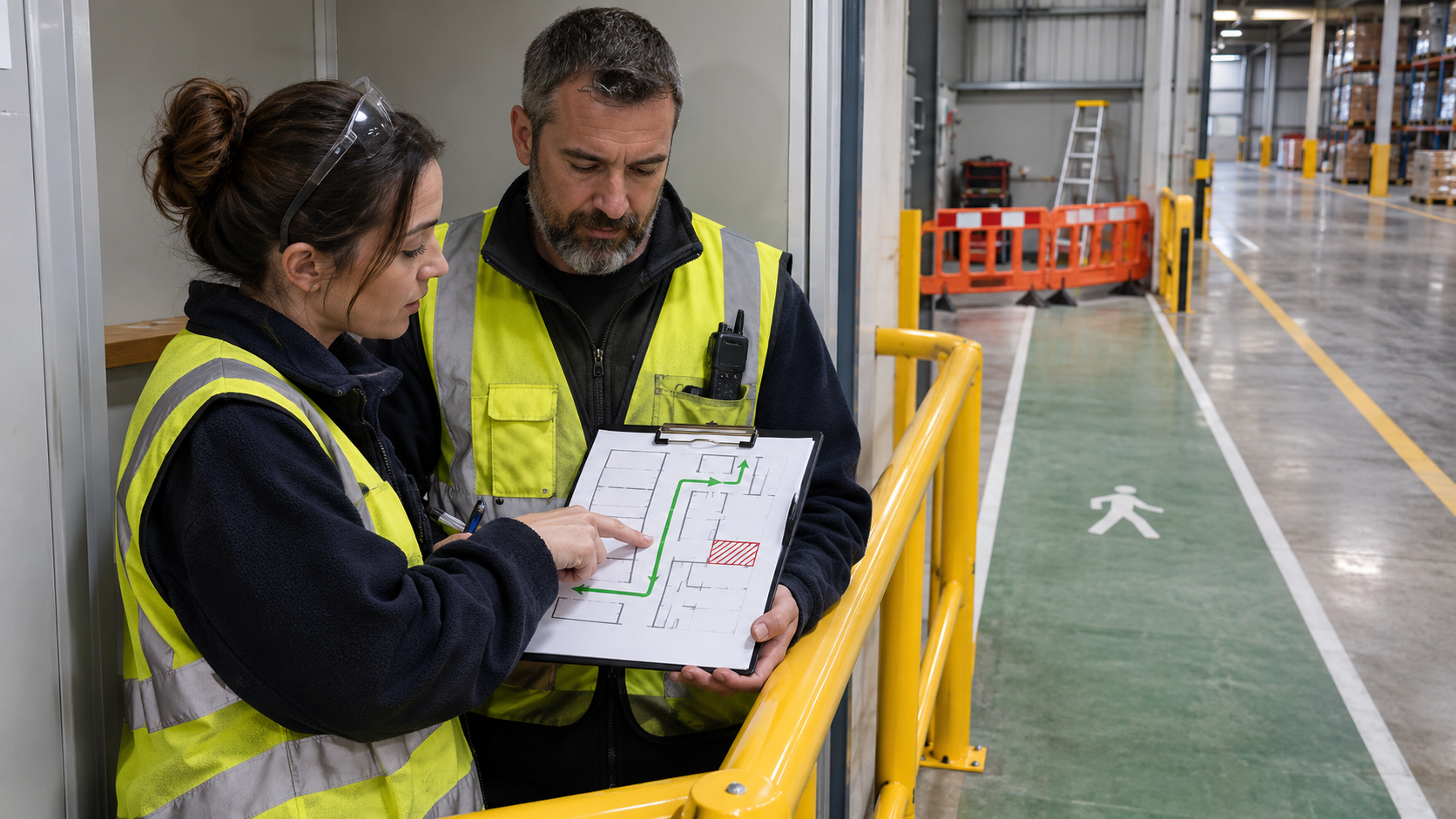
Do not simply equate emergency escape routes with everyday walking routes. Explain their special requirements and the site alarm procedure separately; workplace fire-safety instruction provides the next learning component. Before a shift change, hand over outstanding closures, restrictions and responsible contacts. As a recommended minimum, record the affected section, permitted alternative, action status and person responsible for reopening. An unresolved issue does not disappear when personnel change. With staggered working hours especially, the incoming shift must be able to recognise the current situation without relying on informal recollection.
 AI-generated
Demonstrate understanding and make records useful
At the end, an employee guides the instructor back to the workstation verbally or through a safely arranged walkthrough. They explain the approved route, a situation requiring waiting and the reporting process for an obstruction in their own words. Where communication is difficult, adapt language, pictures and demonstration; merely repeating words is insufficient. Uncertain answers lead to further explanation and another check, not a quiet tick in a box. A local readiness criterion may require the employee to explain these three decisions reliably. This is an operational aid, not a universally prescribed examination.
Alongside the participant and date, record the area discussed, route-plan version, scenarios covered and outcome of the understanding check. Open technical or organisational defects receive their own action, owner and target date. This avoids confusing evidence of learning with evidence that the facility is defect-free. The guide to audit-ready training records helps connect instruction, questions and corrective actions traceably. The additional fields suggested here are practical aids; the legally required documentation depends on the applicable rules and actual activity. Keep training completion and outstanding operational work clearly distinguishable.
A simple decision sequence makes the action log useful: is the area currently safe to use, and is its intended use clear? If not, restrict use under the established site procedure and inform the responsible person. Reopening follows only after the remedy has been checked by the designated role. The shift lead records what changed and who was informed. Completed cleaning, for example, does not establish readiness for reopening if the surface remains slippery or a barrier still blocks the only safe access route.
Run a small pilot with a clear follow-up
Start with one warehouse area and one shift. Before the walkthrough, the responsible person checks that planned routes can actually be used. Afterwards, review unresolved decisions and reported obstructions. A later observation during normal work shows whether people use the approved routes and whether reports receive action. If the same shortcuts recur, investigate the workflow as well as learning needs. Repeating reminders cannot reliably make a cumbersome or blocked access route safe. Follow-up should establish whether the agreed arrangement works in practice, not merely whether everyone attended.
The ConformBase course Safe Work in Warehouse and Logistics can prepare general knowledge about loads, storage, protective equipment and vehicle traffic. The current offer lists a story-based course and a micro-series; the local walkthrough and actual traffic rules remain the workplace’s responsibility. Use the course as one learning component, then add site-specific evidence. A successful pilot means employees can explain their safe route, escalate disruptions correctly and see outstanding actions being addressed. A certificate alone promises neither complete legal compliance nor a safe warehouse operation.
ConformBase
Turn knowledge into training that works.
Bring compliance, privacy and security awareness into a format your people want to complete, with certificates and audit-ready evidence.
Start free trialAsk about custom courses →