Three learning tasks, not one green tick
A medium-sized employer has 48 employees, two shifts and a new receptionist. Everyone has a completed first-aid module in the learning system. Yet the receptionist does not know whom to contact late in the afternoon, and one trained first aider now mostly works from home. This fictional example reveals the procurement problem: completion initially proves only that someone finished a particular activity. It does not establish recognised qualification or practical availability at the workplace. Managers therefore need to assess learning objectives, local arrangements and actual attendance separately, using the German framework explained here.
The first question is not whether to learn online or onsite, but what someone must be able to do afterwards. All employees need orientation on raising the alarm, facilities and appropriate behaviour. They also need to understand their specific workplace. People designated as workplace first aiders need the recognised initial or refresher training for that function. Our overview of online occupational safety instruction explains the broader limits of digital instruction. This article focuses on three distinct outcomes: building awareness, understanding local arrangements and filling a qualified role. Evidence of one outcome cannot substitute for another.
What the official requirements actually say
Section 10 of Germany's Occupational Safety and Health Act requires employers to arrange the necessary first aid, firefighting and evacuation measures. Relevant factors include the workplace, activities and workforce size, with other people present also taken into account. Connections with external emergency services must be established. The provision requires designated employees and an appropriate relationship between their number, training and equipment, the workforce and particular hazards. It therefore calls for functioning arrangements, not merely purchased learning content. A training subscription does not transfer this organisational responsibility or replace assessment of the actual workplace.
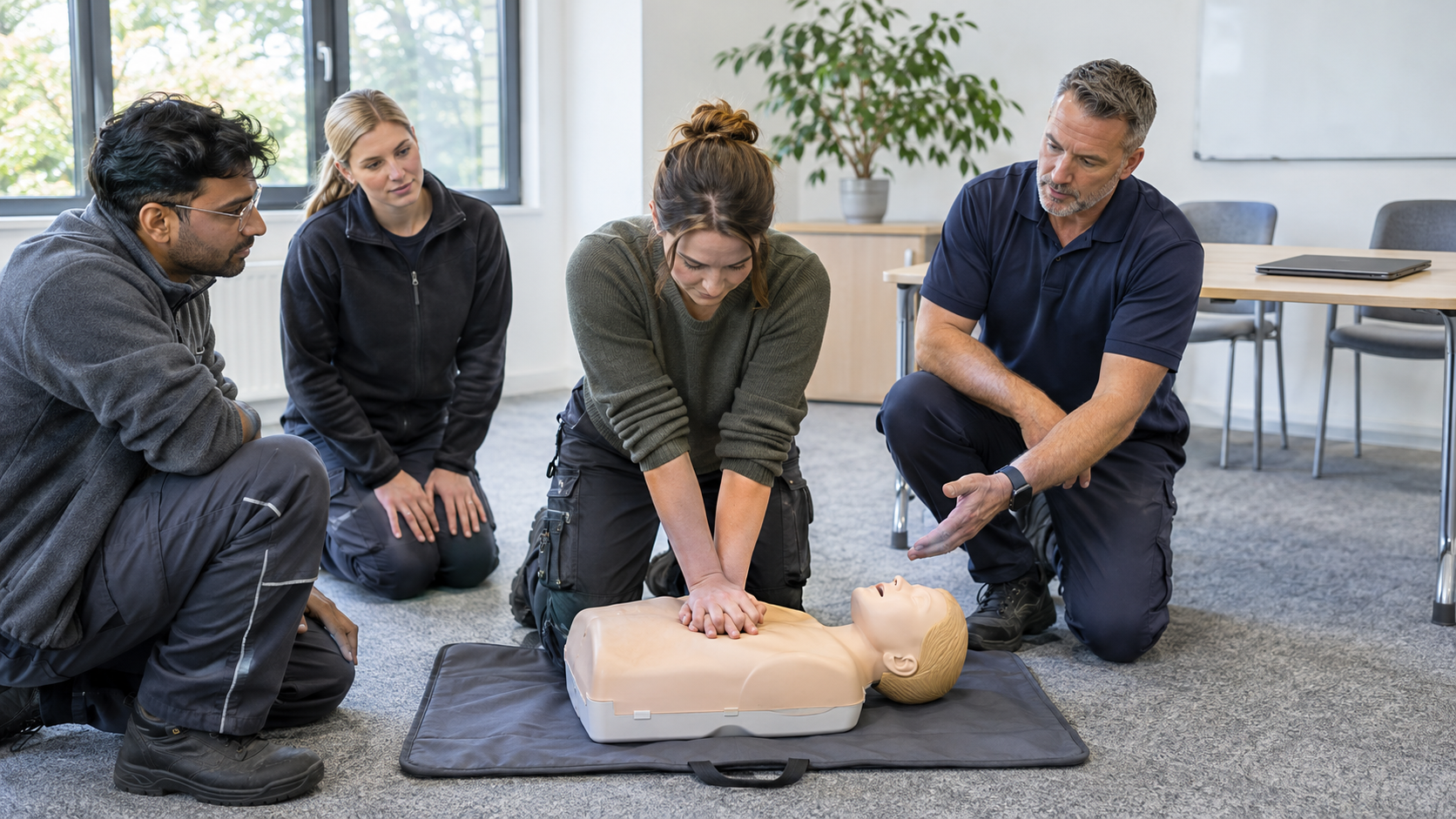
The DGUV page on first-aid instruction specifies regular instruction, at least annually, about facilities and appropriate responses to accidents and acute illness. Topics include available first aiders, emergency calls, reporting contacts, equipment and documentation. This differs from the refresher cycle for workplace first aiders. For the standard qualification route, DGUV describes nine teaching units and refresher training at least every two years, also comprising nine units, delivered by an authorised provider. Planning annual workforce instruction therefore does not organise the designated role's qualification. Equally, attending that course does not establish knowledge of the current workplace.
Level one: awareness with a clear boundary
A digital module can introduce employees to the response chain, emergency calls and organisational questions. Useful tasks might ask learners to identify information needed by a dispatcher or locate the workplace contact list. State the learning objective in observable terms: explaining the prescribed alarm route is more precise than mastering first aid. A knowledge test checks selected answers under learning conditions; it does not observe practical competence during an emergency. This boundary should appear in the assignment and the explanation given to supervisors, rather than being left in an obscure provider disclaimer.
ConformBase's first aid and workplace emergencies offer describes a story course and a micro-series, each lasting approximately twenty minutes, with a final test and certificate. Procurement should treat that certificate as evidence of completing the digital offer, not as recognised workplace first-aider qualification. The DGUV FAQ on online courses explicitly excludes online delivery for initial and refresher first-aid courses under DGUV Regulation 1 because practical competence must be developed. A sound purchasing decision therefore combines digital preparation, local instruction and a separately arranged recognised classroom course wherever the person's role requires one.
Level two: understand the actual workplace
Local instruction starts where a general course ends. The new receptionist walks the designated emergency access route with a responsible colleague, identifies the precise location description and finds the current contacts. They check where first-aid supplies are kept and how assistance can be reached when reception has only one person. The key is not ticking off a tour but asking the employee to explain the location and who guides arriving responders. An unclear answer reveals a gap in the arrangements, not simply a reason to replay the same video without addressing the local problem.
 AI-generated
Arrangements must fit the shift, building and activity. In rented offices, a building notice may list different contacts from the employer's own procedures; in a warehouse, a side entrance may be locked outside normal hours. Resolve these differences before accepting the arrangements. Fire safety in multi-tenant buildings illustrates the related problem of divided responsibilities. Do not copy another organisation's alarm chain without checking it. Agree your own route with the relevant parties instead. A concise, accessible location card can help, provided someone owns it and updates it when access arrangements change.
Level three: verify qualification and coverage
For the standard first-aider course, the responsible coordinator first checks the training provider's authorisation, then the course type and date. A generic attendance certificate, general safety seminar or completed online module is insufficient. Different rules may apply to people with medical or emergency-service qualifications; assess these cases using DGUV guidance and, where necessary, the responsible accident insurance institution. Neither reject every prior qualification automatically nor accept it without review. Once the qualification is verified, arrange the workplace designation and communicate the function the person will actually perform within the organisation.
DGUV specifies at least one first aider for two to twenty insured persons present. Above twenty, the stated minimum is five percent in administrative and commercial businesses and ten percent in other businesses, with separate provisions for certain settings. Presence is the crucial planning variable. A list of everyone holding a certificate does not establish late-shift coverage. Apply the logic of a workforce emergency plan with deputies to account for holidays, illness, remote work and separate work areas. Adequate actual provision still requires assessment of the workplace circumstances, not merely a percentage in a spreadsheet.
A practical decision process for HR and managers
Start assignment with a role question: does this person need general awareness, orientation at a particular workplace, or appointment as a first aider? For general awareness, select suitable content and questions that check understanding. For local instruction, add the workplace, responsible instructor and a practical orientation check. For the designated role, also verify recognised qualification and availability. Record these three decisions in separate fields. A single first-aid-completed flag conceals important distinctions and may lead workforce planners to assume that qualified first aiders are available when only an awareness module has been completed.
Next, give each unresolved item an owner and a verifiable outcome. HR might coordinate bookings and certificates; the site manager confirms local routes and contacts; the supervisor checks actual staffing. This allocation is an organisational choice, not a legally prescribed set of job titles. The guide to training records without spreadsheets helps separate content, version, individual and completion. First aid additionally requires the type of qualification to be explicit. A record should show what was verified and what remains outstanding. Missing evidence cannot be replaced by renaming a course or manually changing its status to green.
Two cases for a short team exercise
In the first exercise, an employee reports that someone in a meeting room needs help. The group should not improvise medical treatment. Instead, participants explain their alarm route, exact location and allocation of organisational tasks. Who summons assistance, who guides responders, and which entrances must remain accessible? Clearly announce the activity as an exercise and do not place a real emergency call. Observe whether answers are understandable and connect into a workable sequence. If nobody knows the building designation, correct the location information before briefly discussing the same scenario again to check the improvement.
In the second case, the scheduled first aider becomes unavailable at short notice, while a new colleague has completed only the digital module. The manager must not reinterpret that learning certificate as a professional role qualification. They check the planned cover and arrange an appropriate solution for the actual attendance situation. Compare this with separating fire-safety instruction from exercises: knowledge, practical preparation and designated functions involve different evidence. The debrief should therefore examine not only the correct answer but also how workforce planning will detect and respond to similar absences early enough in future.
Separate evidence and protect health information
An instruction record shows who received which workplace-specific information, when it was delivered and how unresolved questions were handled. A certificate from an authorised provider evidences the particular first-aider course instead. Workplace designation and current coverage planning add further information, but they are not the same document. Do not store an uncategorised PDF and assume its meaning is obvious. Identify the purpose and check whether the responsible person can distinguish the records. During provider changes, avoid automatically mapping old completion types into new qualification fields: this can produce a complete-looking but substantively inaccurate history.
 AI-generated
Records of first aid actually provided belong in a separate category. DGUV requires documentation even for minor incidents, specifies retention for at least five years and requires protection against unauthorised access. That rule concerns treatment records, not every learning record indiscriminately. Health information therefore does not belong in a training dashboard visible to all managers. GDPR training for employees supports the necessary separation of access. Fictional cases without real patient information are sufficient for organisational exercises. When reporting a procedural weakness, describe the process and avoid unnecessary details about an individual employee's health.
Introduce a small, verifiable pilot
Start with one location and a small group involving reception, a manager and a designated first aider. Review existing evidence, check contact lists and assign the three learning tasks before the pilot begins. Participants then complete the selected digital content and local instruction, while any required recognised courses are organised separately. Close the pilot only once outstanding organisational issues have been resolved. A high completion rate is merely one indicator. Also ask whether each checked shift has the planned provision and whether employees can explain the precise alarm route relevant to their own workplace.
For approval, review three pieces of evidence together: the clearly scoped learning record, confirmed local arrangements and verified first-aider qualification with staffing coverage. This pilot review is a practical recommendation, not an additional official certification. Recheck affected information after relocation, shift changes or staff turnover. The purchasing principle remains straightforward: digital learning can prepare people and refresh knowledge, but a general completion record does not become a recognised first-aider course. Suitable learning, local orientation and a properly qualified, staffed function must work together to create dependable arrangements for the actual workplace.
ConformBase
Turn knowledge into training that works.
Bring compliance, privacy and security awareness into a format your people want to complete, with certificates and audit-ready evidence.
Start free trialAsk about custom courses →