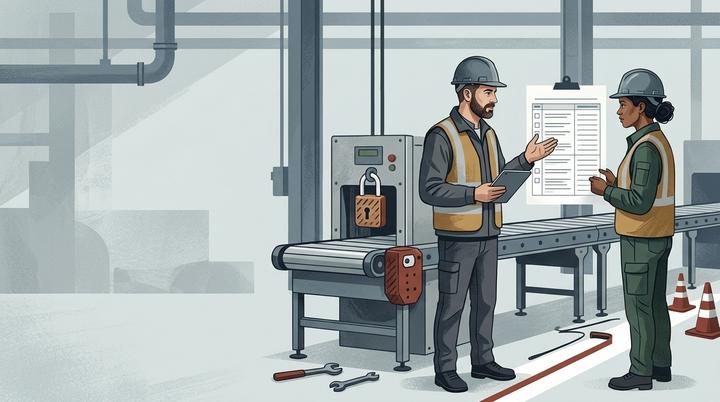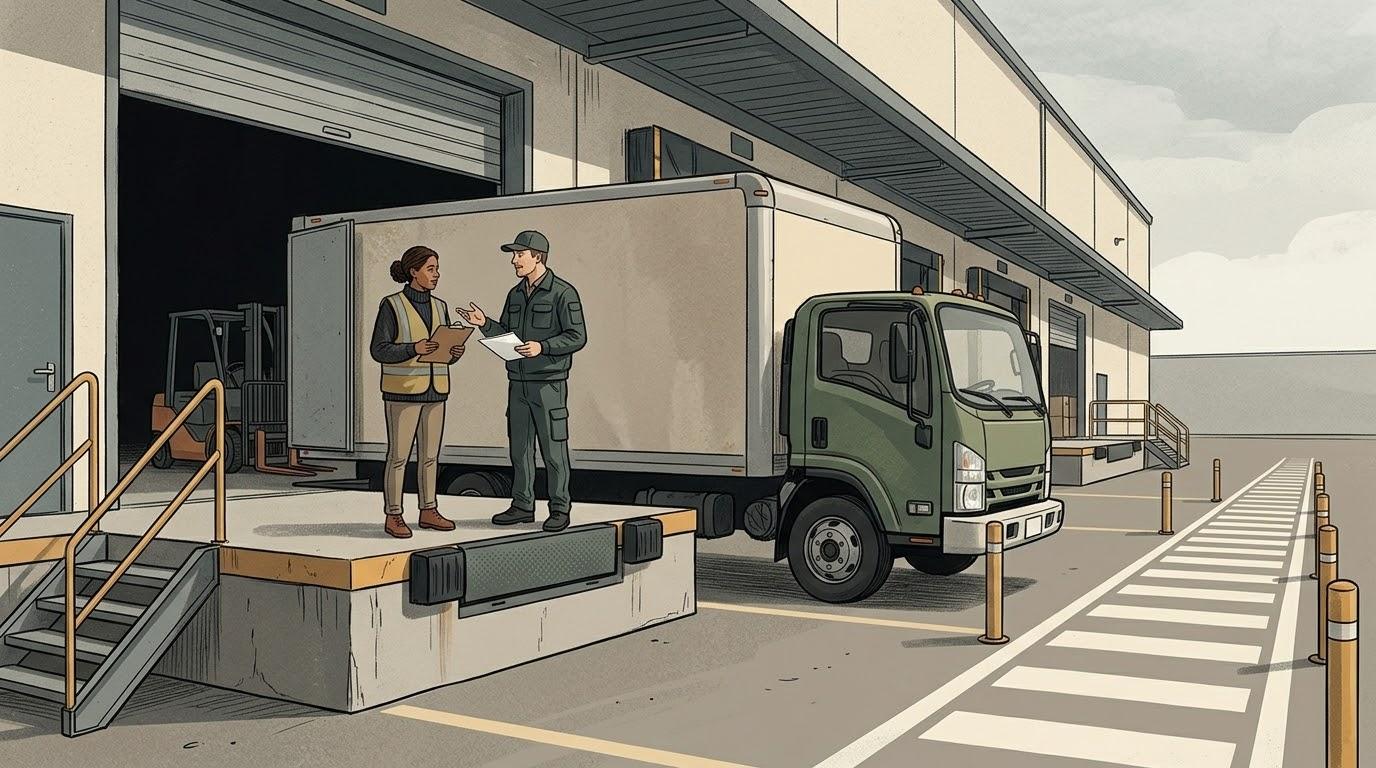
Transport vehicle training: A lorry waits at the dock
Warehouse supervisor Sara is expecting a delivery. The driver reaches the dock while an industrial truck is moving inside the building. The schedule is tight and the previous contact is handing over at shift change. Who directs the driver to the waiting area? Where should the driver stay during unloading? Who confirms when the vehicle may depart? These interfaces belong in transport vehicle safety training. Sara reviews a specific handover with the warehouse team and drivers working at the site rather than relying on a list of prohibitions. The example is fictional; the local risk assessment and actual facilities determine the safeguards.
Before arrival: Identify hazards and roles
Sara reviews site routes and procedures with the responsible manager: where do pedestrians and vehicles intersect? How are vehicle movements announced? Which dock, vehicle and handling equipment are planned? She establishes who receives the driver, coordinates unloading and can decide what happens after a disruption. Deputies and contact details matter too. A name on a sheet does not replace authorisation or required competence.
Section 12 of the German Occupational Safety and Health Act requires adequate and appropriate instruction related to the workplace or task, adapted to changing hazards and repeated regularly where necessary. For work equipment, section 12 of the Industrial Safety Ordinance additionally requires instruction before first use and at least annually thereafter. The content relevant at Sara's dock depends on the task, equipment and risk assessment.
Arrival: Make the handover understandable
Before driving to the dock, the driver receives understandable instructions about the applicable route, assigned waiting area and contact. Sara asks the driver to explain the route and where to wait during unloading. Where language is a barrier, the team uses suitable translations or clear visual prompts and checks their meaning together. A signature alone does not show that both sides understand the same procedure.
If the driver works for another company, section 8 of the German Occupational Safety and Health Act requires the employers to cooperate on occupational safety. Sara therefore coordinates site information with the transport company rather than treating general driver training as complete knowledge of the site. The guide to handovers between companies explores how responsibilities can be clarified at interfaces.
At the dock: Coordinate vehicle, people and equipment
Under the local procedure, the vehicle is positioned at the assigned dock and secured against unintended movement. Appropriate responsible personnel explain the available devices and checks using the actual vehicle and dock. Sara asks the team who applies the safeguard, who checks its condition and what happens if it fails. A generic instruction to use a particular device cannot replace the local assessment.
Before work starts, the driver and warehouse team also agree where people may stand, how the danger area will be kept clear and how the vehicle and dock will be connected safely. The team checks the equipment under site rules. If a prerequisite is missing or the condition or responsibility is unclear, the affected work does not start. Whoever releases the dock must actually be authorised under the site procedure.
Practical tool: A dock handover sheet
Sara uses a short handover sheet as an organisational aid, not a statutory template. It supports site procedures and replaces neither technical checks nor risk assessment. For each open item she records an owner and the next decision. The sheet may be digital or on paper; what matters is that the driver and warehouse team understand its current status.
- Delivery, vehicle, dock and handover time.
- Receiving person, driver, coordinator and deputy with contact route.
- Traffic route, waiting area and agreed location during work.
- Planned safeguards and equipment and the person responsible for checking.
- Start of loading or unloading: decision, conditions and outstanding items.
- Disruptions, pauses, reporting and any necessary renewed coordination.
- Completion, confirmation by all parties and decision on departure.
During work: Stop and report changes
In Sara's scenario, a loading device does not work as expected. The warehouse team stops the affected activity, keeps the danger area clear and informs the responsible person. The driver and team do not improvise a workaround on their own. Work can resume under site rules only after responsible personnel assess the deviation and establish a safe way forward. The same applies if the vehicle's condition changes or another traffic participant enters the area.
If the shift changes meanwhile, Sara explicitly hands the status to the incoming person: what is complete, which safeguard remains in place, and who decides on open issues? A gap between responsibilities must not be interpreted as permission to depart. The maintenance handover guide also explains clear handover and approval principles.
Completion: Treat departure as a separate decision
After unloading, the responsible person reports completion. Under the local procedure, driver and warehouse team check that equipment has been removed from the area, people are clear and the required return steps are complete. Only the designated authorised person gives the agreed departure confirmation. Sara asks participants to explain the signal and what they do if it does not arrive. An open door or empty vehicle alone is not reliable permission to depart.
Practical exercise: Three roles, four observable outcomes
Sara assigns three roles: driver, warehouse coordinator and observer. In a tabletop exercise using a site plan, driver and coordinator practise the arrival handover, complete the sheet and agree the sequence. The observer then introduces a defective loading device and later a shift change. No real vehicle movements or interference with safeguards are performed for the exercise.
The observer checks four outcomes: Can both parties name the route and waiting location? Are safeguard checks and ownership clear? Is the affected activity stopped and the right person informed when a fault appears? Is an unambiguous confirmation obtained before departure? If an outcome is missing, Sara discusses the gap and repeats the step. Choosing practical exercises helps adapt the task to different jobs. A tabletop exercise does not replace required practical competence or site-specific instruction.
Document and follow up the instruction
Sara records who was instructed, when and on which topics, along with outstanding questions and follow-up actions. Section 12 of the Industrial Safety Ordinance requires documentation of the employee instruction it governs. The responsible manager tracks open actions and checks after changes whether the procedure and instruction need updating. Attendance alone does not prove that a dock or vehicle is safe.
Digital learning can prepare foundational knowledge and shared terminology. ConformBase course previews help select learning material; the actual dock induction, on-site checks and departure decision remain separate responsibilities of the designated people.
ConformBase
Turn knowledge into training that works.
Bring compliance, privacy and security awareness into a format your people want to complete, with certificates and audit-ready evidence.
Start free trialAsk about custom courses →Won through a public tender: AI literacy for DIW Berlin, from kick‑off to sign‑off in one month.