
A maintenance job starts with an apparently modest request: open an old enclosure, remove mineral deposits and clean the area afterwards. What matters for employees is whether the material and the actual working method have been assessed. Calling the workplace a steel plant tells them little about the dust that a particular task may release. Effective silica dust instruction therefore does not teach visual material diagnosis. It teaches which information must be available, how to recognise a departure from the agreed task and who can authorise work to resume after competent assessment.
This guide is for supervisors, maintenance teams and training owners operating under German law. It adds decision cases about silica-containing materials and unidentified legacy components to workplace-specific safety instruction. A digital learning unit can prepare participants and organise comprehension questions, but it does not replace risk assessment or the required oral instruction for the actual workplace. The release fields and exercises below are suggested local procedures, not statutory forms. Passing a knowledge check does not authorise anyone to disturb suspect insulation or take samples from it.
1. Recognise silica dust risks without guessing materials
Silica-containing dust can arise when relevant mineral materials are worked, including silica-containing moulding materials or refractories. Composition, the task and exposure matter, not just visible dirt. TRGS 559 on silica-containing dust addresses work involving quartz and cristobalite dust and explicitly excludes asbestos. Teams need to understand that boundary: controls assessed for a known silica-containing material cannot automatically be transferred to an unidentified old component. An unknown composition remains an unresolved question until reliable information is available. The task description should make clear which material the assessment actually covers.
A simple health explanation is sufficient for the exercise: inhalable dust can include a respirable fraction, and respirable silica dust can cause serious lung disease. An absence of coughing, smell or obvious haze is not evidence of safety. Employees should not estimate concentrations. Competent people assess exposure and whether controls work. The existing guidance on welding fume instruction provides a useful comparison for source capture and fault reporting, but not material identification. Welding fume, mineral dust and fibrous dust each need an appropriate assessment. Sharing a workshop does not make their hazards interchangeable.
2. Establish an information checkpoint before work
Start preparation with four questions: which component will be touched, what material is documented, what intervention is planned and who might be affected? An instruction such as 'clean the area' is inadequate if it would require opening an enclosure or removing an old coating. Under section 6 of Germany's Hazardous Substances Ordinance, information gathering and competent risk assessment belong in preparation. If information about structural or technical installations is insufficient, further examination and, where necessary, external expertise are required. Any technical investigation needed for the assessment must precede the affected work.
A short job card can record the asset identifier, precise scope, material records, approved method, contact person and stop conditions. Mark missing information as unresolved instead of replacing it with assumptions. The card is not a second risk assessment; it points to the applicable approved version. Even a negative investigation result needs context: which component, layer and investigation scope does it cover? A result from another room or construction phase does not automatically transfer. Supervisors should explicitly expect this question during practice, rather than rewarding a confident but unsupported answer.
Contractors introduce another handoff. Section 5a GefStoffV requires the party commissioning work to provide available construction or use-history information about known or suspected hazardous substances beforehand, in writing or electronically. The executing employer must assess that information for its own risk assessment. Teach these responsibilities separately. Guidance on coordinating contractors helps connect contacts, induction and handover. However, a signature on general site rules does not resolve an unidentified material, and a customer's deadline does not make an unresolved job ready to perform. The contractor needs a clear route for raising missing information.
3. Teach controls as conditions for doing the job
Instruction should explain the locally assessed controls: lower-dust materials or processes, effective capture at the source, organisational limits and any required personal protective equipment. At a safe demonstration point, ask employees to show how they recognise the intended operating condition and report a fault. A mask is not a substitute for failed extraction unless a competent assessment has specifically established an alternative procedure. The decision is not to finish quickly before anyone notices. It is to have the agreed safe conditions restored through the defined escalation route.
Cleaning needs to be planned as a separate task. BGHM's guidance on dust hazards describes low-dust methods, suitable extraction, hygiene and avoiding dry sweeping or blowing dust off surfaces. Ask the group to explain which approved cleaning method applies in its area and what happens when the equipment is unavailable. Avoid a blanket instruction to use water: near molten metal or where other technical hazards exist, wet cleaning can create additional risks. Instruction on molten metal and moisture helps explain this conflict. The method must be assessed for the actual combination of hazards.
Likewise, a vacuum suitable for one dust must not be treated as a universal appliance. Composition, possible fire or explosion hazards and intended use all have to fit. The article on task-based explosion protection explains why equipment, substance and working procedure need to be considered together. Practise a simple statement: 'This equipment is specified for this approved job; suitability for a different material needs checking.' Employees should neither select filter classes independently nor infer suitability for unidentified fibrous dust from the appearance of a vacuum. Equipment familiarity is not an assessment.
 AI-generated
4. Unidentified legacy materials end the routine
An older gasket, insulation or enclosure is not necessarily asbestos-containing simply because of its age. Conversely, colour, fibre appearance or an unremarkable smell does not establish safety. Teach this uncertainty explicitly so employees do not invent either reassurance or a diagnosis. Where a relevant suspicion is unresolved, the affected intervention is not started, or is safely interrupted under the site procedure. The material is left undisturbed. A designated competent person determines the next steps. Employees must not scrape, break, drill or collect a supposedly small sample to prove their suspicion.
TRGS 519 on asbestos work demonstrates that relevant demolition, refurbishment and maintenance tasks have their own requirements. This article supplies neither the necessary qualification nor a working method. Local instruction should instead explain how unauthorised disturbance is prevented, who must be contacted and how neighbouring activities are considered. If a release has already occurred, the site's incident or emergency procedure applies. Nobody should be sent into a potentially contaminated area just to look more closely. Work resumes only on the basis of the necessary specialist clarification and the applicable controls.
5. Use three cases instead of a generic dust presentation
Case one: extraction indicates a fault during planned work on a known mineral material. The group should not vote for a stronger mask. It should identify the agreed stopping point, reporting route and conditions for restarting. A useful practice report contains the asset identifier, affected task, observed fault and current work status. The supervisor then checks whether the contact is reachable and release responsibility is clear. If the group cannot answer, the problem may extend beyond knowledge: the local procedure itself may be incomplete or inaccessible at the point of work.
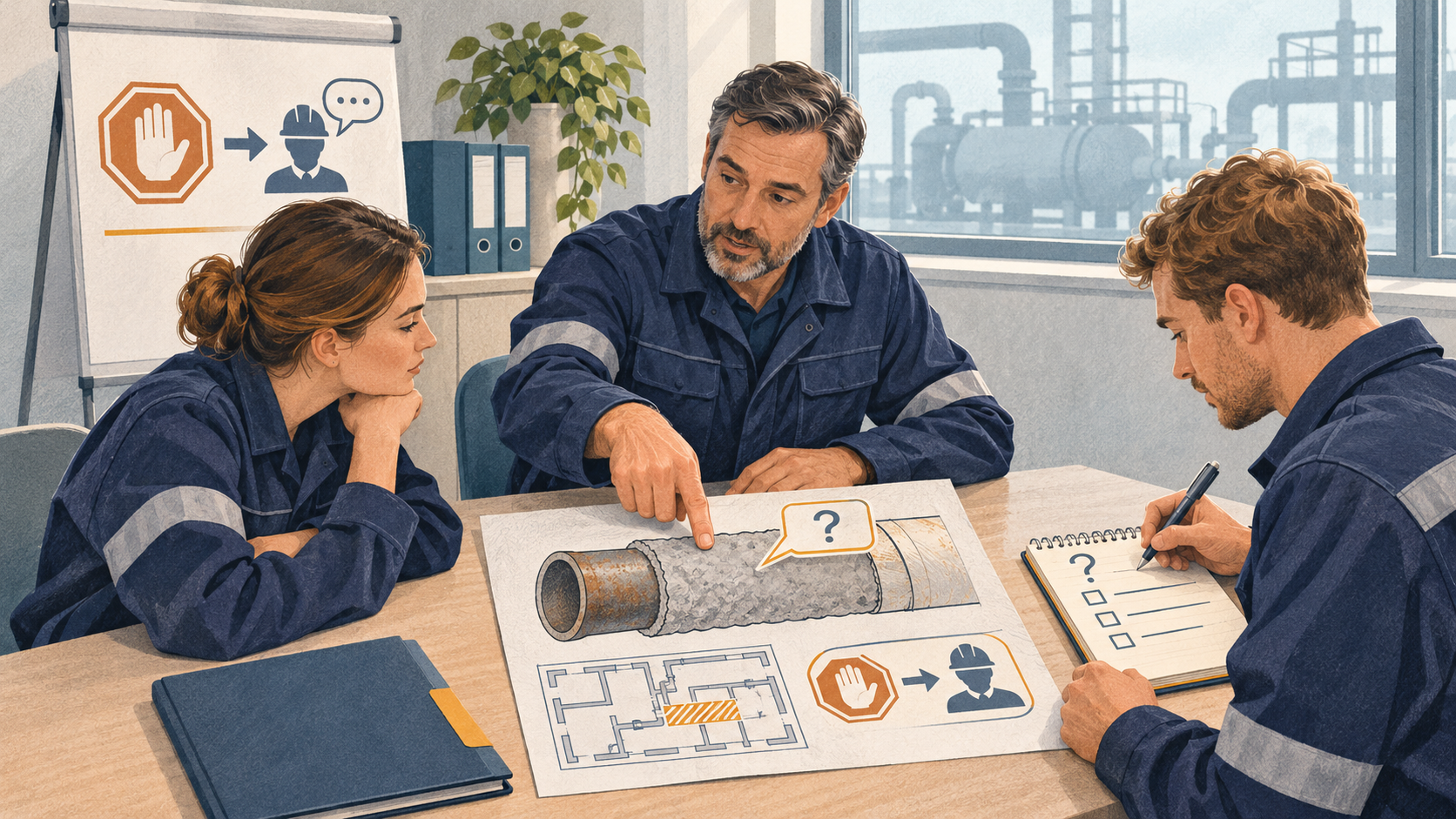
Case two: a contractor encounters an undocumented layer behind an enclosure. The planned job does not clearly cover that layer. The right decision is not to expand the intervention, but to report the information gap. Have two participants role-play the conversation between plant and contractor. One asks about the exact location and available records; the other confirms which work is paused. A photograph taken from an already safe position may document an observation, but it is not material identification and does not justify moving closer or disturbing the material for a better picture.
Case three: a deposit is to be cleared before the shift ends, but the specified cleaning equipment is unavailable. A colleague suggests compressed air. The exercise should not end with a bare refusal. Participants need a workable alternative: arrange cleaning using the approved method, manage the affected area under the local procedure and inform the next shift. They should name who will obtain the equipment and who decides whether other operations can continue. This turns a safety rule into an operational response that remains usable when time pressure makes improvisation attractive.
 AI-generated
6. Connect oral instruction with meaningful evidence
For hazardous-substance work, section 14 GefStoffV requires understandable written operating instructions and oral, workplace-specific instruction based on them before employment begins and at least annually thereafter. Content and timing must be recorded in writing and confirmed by participants' signatures. General occupational-medical and toxicological advice is also part of the instruction, with the relevant physician involved where necessary. Plan these elements explicitly. A calendar appointment or automatically generated completion certificate alone does not establish which workplace was discussed or whether the required explanation was understandable to the people performing the work.
Useful additional evidence includes the operating-instruction version, asset area, cases discussed and unresolved actions with named owners. These extra fields are an organisational recommendation. Audit-ready training records help maintain the connection between the person, content and version. Individual medical findings do not belong in a general attendance list. Keep the evidence types distinct: material investigation, risk assessment, instruction and work authorisation answer different questions. A complete training record cannot replace missing material information, just as a material result cannot replace instruction. The record should make those boundaries apparent to a later reviewer.
7. Start with one clearly defined work area
Begin with one asset area and a real upcoming task. The responsible supervisor works with competent specialists to check that records, methods, equipment and reporting routes fit together. Follow this with a short case exercise that creates no actual dust exposure. Assess decisions rather than technical vocabulary: what may begin, what remains unresolved and who will resolve it? The overview of mandatory employee training helps position this unit within the wider training plan. It does not replace checking the particular requirements that apply to the hazardous-substance task under discussion.
ConformBase can be considered as a starting point for structuring and organising workplace learning; its current German steel offer lists silica dust and asbestos in existing installations within the processing module. Before commissioning anything, check the exact scope and its limits against required specialist qualifications. The objective of this instruction remains deliberately narrower: employees recognise the boundaries of their task and reliably trigger the right clarification. After the first exercise, resolve unclear contacts, missing records and poorly defined job descriptions. Only then extend the unit to additional areas of the plant.
ConformBase
Turn knowledge into training that works.
Bring compliance, privacy and security awareness into a format your people want to complete, with certificates and audit-ready evidence.
Start free trialAsk about custom courses →