One setup, three contractors and a blocked route
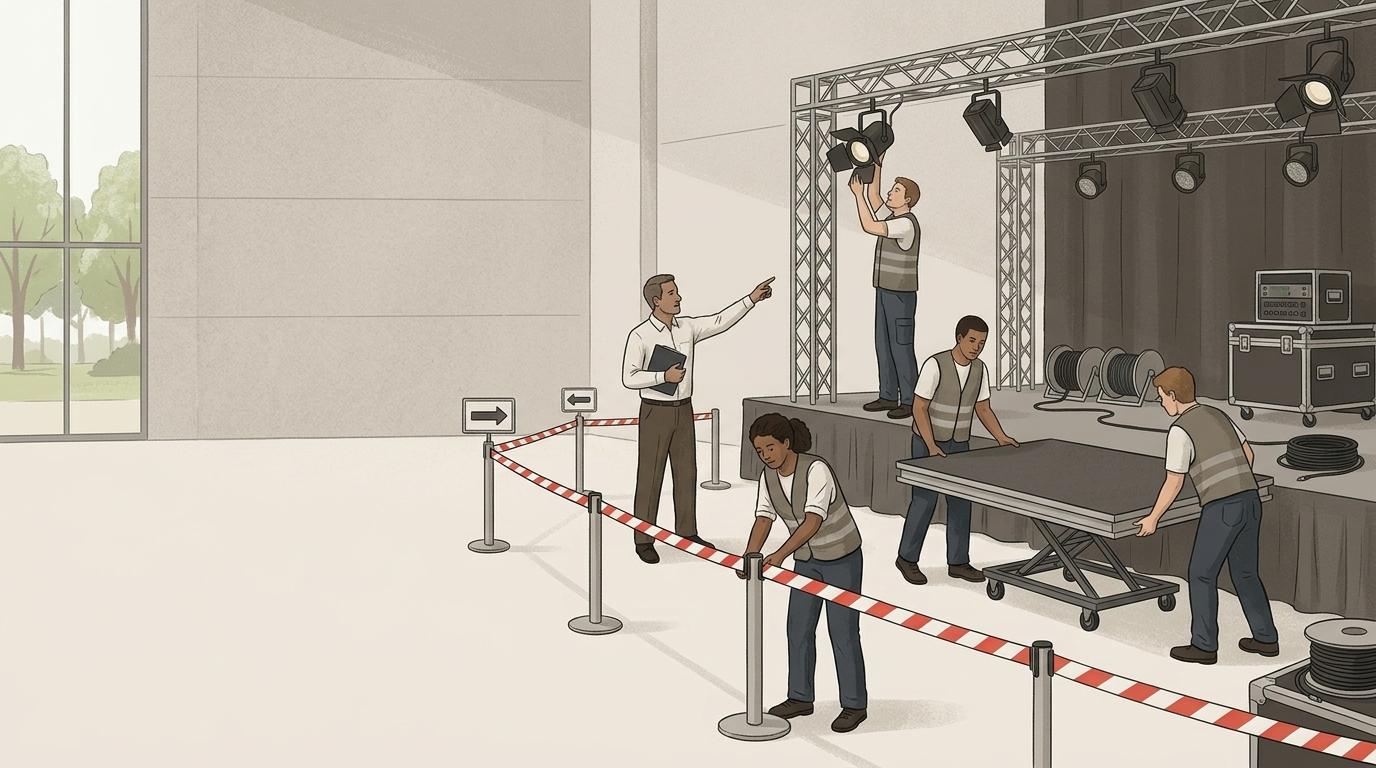
Event safety instruction is tested beyond the training room. For a fictional evening event, production manager Mara coordinates stage, lighting and seating setup. As the lighting crew moves equipment through a work area, the seating team delivers chairs across the same space. The agreed barrier is missing. Mara must decide which work has to wait and who will resolve the situation with the companies involved.
This article is for people responsible for work in Germany. It offers an organisational aid for instruction, not a universal authorisation for event work. Actual safeguards depend on the risk assessment, tasks, venue and applicable rules.
Before setup: who instructs and who coordinates?
Mara asks each company to name an available responsible contact and deputy. Employers remain responsible for instructing their own workers. When employees of several employers work at one workplace, section 8 ArbSchG requires cooperation and, where necessary for safety and health, information sharing and coordination of protective measures. Central coordination helps but does not replace these duties.
Coordination starts with a shared schedule: who works where, when and with which equipment? Which task affects another area? Mara checks traffic routes, deliveries, work at height and restricted areas. She assigns responsibility for erecting and checking barriers, communicating changes and escalating unresolved interfaces. Each company translates that information into instruction for its own team.
Event safety instruction: derive content from the task
Instruction must address the hazards and work involved. Section 4 of DGUV Regulation 1 requires instruction as necessary, at least annually, and documentation. Annual generic instruction alone does not resolve conditions at a changing venue or today's interfaces. Mara collects site-specific hazards in advance and ensures responsible managers pass new information to their teams before affected work.
For work equipment, section 12 BetrSichV requires task-specific instruction before use, based on information from the risk assessment. Workers must receive information in a comprehensible form and language; the date and names of those instructed must be recorded in writing. Before deployment Mara checks which equipment will actually be used and whether the particular work needs additional qualifications or authorisation. A general event induction does not replace this check.
At the venue: compare the plan with reality
Before work begins Mara walks the planned routes and work areas with the contacts. She checks that agreed barriers are visible and effective, materials can be delivered safely and contacts can be reached. Workers need to know where they may go, how to respond to a deviation and how to summon help. If conditions differ from the plan, the affected work is held until resolved rather than improvised.
Mara does not merely ask whether everyone understood. One person from each team explains their route and shows where they would wait if access were blocked. The guide to assessment questions and exercises helps turn these observations into verifiable criteria. For the lighting team, it also matters who may enter the restricted area and how other contractors are informed in time.
A handover sheet for setup and breakdown
Mara uses a shared sheet as an organisational aid. It does not replace participating employers' risk assessments or required technical checks and authorisations. Responsible contacts keep it current and communicate changes to teams on site. These fields support a traceable handover:
- Event, date, phase and clearly identified work area.
- Tasks, participating companies, responsible contacts and available deputies.
- Hazards and interfaces, including concurrent work.
- Agreed safeguards, owner and verified implementation status.
- Traffic routes, restricted areas, emergency contact and assembly point.
- Instruction, site information, participants and unresolved questions.
- Changes, affected task, stop decision and owner of resolution.
- Handover to the next phase with time, open issues and agreed prerequisites.
Each open item gets an owner and a deadline before the affected work. A tick without a check does not establish that a barrier is actually in place. The team leader checks the agreed measure and reports the result; only then can Mara and the parties decide whether prerequisites for the next step are met.
When conditions change: pause affected work
In the scenario the barrier between lighting and seating is missing. Mara stops the affected movements and keeps people out of the uncertain zone. She contacts both team leaders, confirms actual work status and agrees who installs and checks the barrier. An alternative route is used only after the parties assess its hazards and effects.
Each team leader then informs their workers of the change. Mara records the decision, safeguards and remaining restrictions on the handover sheet. If a responsible person cannot be reached or a safeguard remains unclear, the affected task remains on hold. Other tasks may continue only if their safety has been established independently of the unresolved interface.
Before breakdown: do not simply reverse the setup plan
After the event the space has changed: guests are leaving, equipment is being collected and other contractors are starting work. Before breakdown Mara checks with the venue and teams which areas are actually clear, which routes apply and whether planned safeguards still fit. A schedule alone does not make a space safe. Status is handed to the next responsible person and coordinated again when conditions change.
For new or later-arriving workers the responsible manager arranges the necessary task- and site-specific information before affected work begins. Mara checks that the contact chain still works at shift change and that open issues actually reach the next team. A signature on a list alone does not show whether a worker can explain a changed traffic route safely.
Exercise: identify the missing barrier
Three roles suffice: lighting team leader, seating team leader and observer. The starting point is a plan with separate routes; a diagram shows the barrier missing. The two leaders identify the affected work, agree to stop it and contact Mara. They then agree on a safeguard, verification and team communication and complete the handover sheet. The observer asks what happens if the contact is unavailable.
The outcome is verifiable if four points are visible: affected work stopped; hazard and contact route identified; safeguard, owner and verification agreed; decision and open issues recorded. If one is missing, explain and repeat. The simulation replaces neither real work authorisation nor equipment-specific practical qualification.
Capture lessons and prepare the fundamentals
After breakdown the responsible contacts compare plan and reality: where were routes blocked? Which change arrived too late? Was a deputy reachable? Mara assigns each improvement an owner and checks before the next event whether it was implemented. Instruction records and job documents are handled according to applicable organisational and legal requirements; no universal retention period is assumed here.
The ConformBase course previews show digital learning modules that can prepare shared foundations. Compare their content with the actual tasks and add necessary local information and practical exercises. Responsibility for safe conditions and coordination between participating employers remains with the responsible parties.
Official sources
ConformBase
Turn knowledge into training that works.
Bring compliance, privacy and security awareness into a format your people want to complete, with certificates and audit-ready evidence.
Start free trialAsk about custom courses →