
1. Ask the sanctions question before ordering
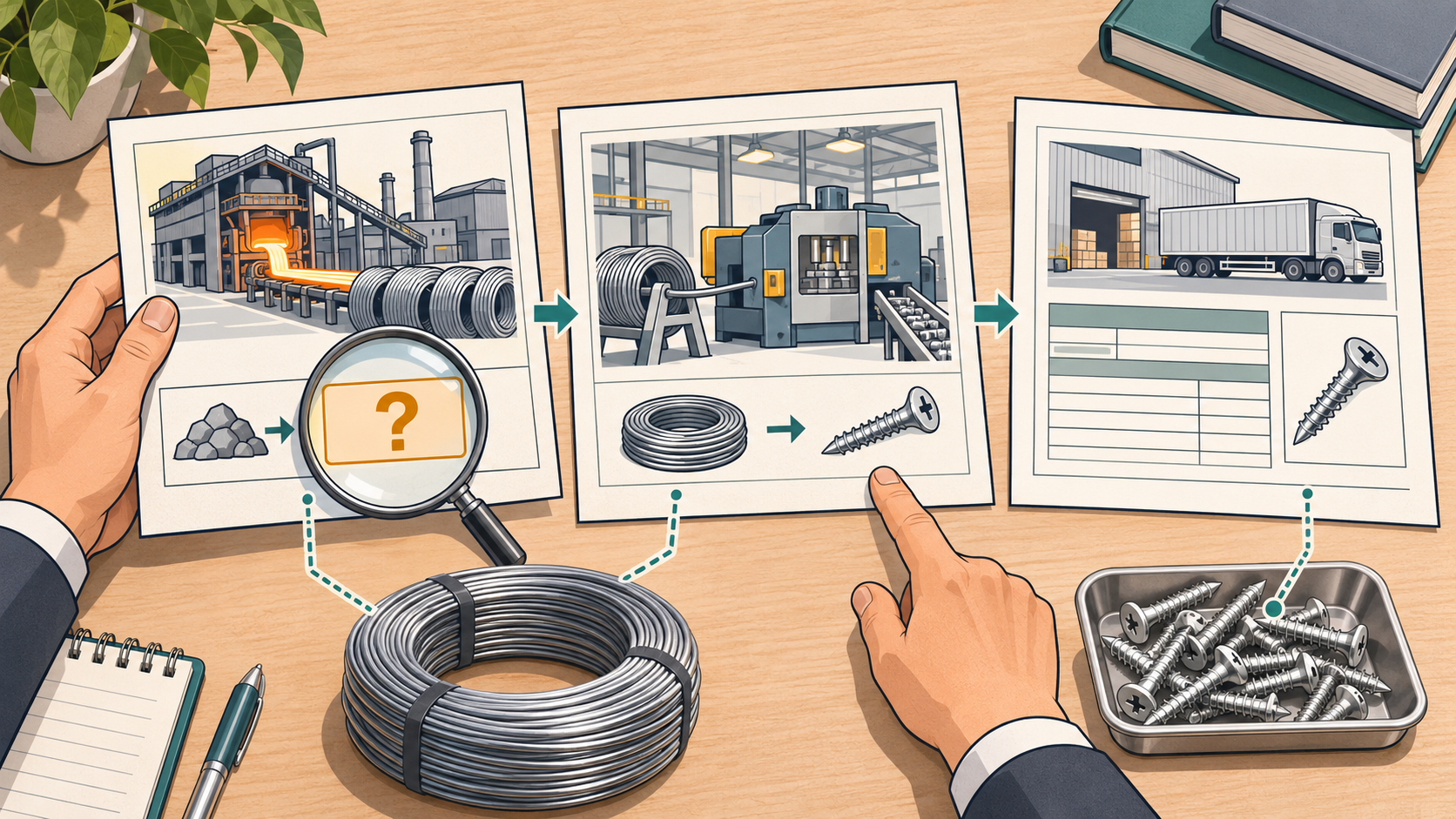
A German steel distributor orders fasteners from a manufacturer outside the EU. The invoice and certificate of origin name the manufacturer's country. Further enquiries reveal that the wire rod used came from somewhere else. For sanctions screening, asking where the finished item was last processed is therefore insufficient. Procurement, customs and compliance need to trace the relevant inputs. This guide develops a material evidence file with clear decision points. The checklist is an organisational recommendation, not an official form or authorisation for a particular import. The official sources used were checked on 5 November 2026; the jurisdiction remains Germany and the EU.
The starting point is Article 3g of Regulation (EU) No 833/2014. It contains different prohibitions concerning specified iron and steel products with a Russian connection. Paragraph 1(d) addresses covered products processed in a third country using covered Russian inputs. The assessment must therefore connect the finished goods with the material used to produce them. The customs function identifies the applicable rule for the actual goods and transaction. A training slide saying that the supplier is not based in Russia does not answer that question. A clear business-partner screening result does not replace the material assessment either.
2. Establish scope and timing through specialist review
Start with the product description, verified tariff classification and intended movement of goods. The Commission FAQ on listed goods explains that, for paragraph 1(d), both the imported product and the Russian input must fall within the relevant Annex XVII. This is not a blanket prohibition on every object containing metal. A finished coated component and its input material may have different classifications. Procurement gathers technical details; the responsible specialist confirms classification and records its basis. A code copied from a supplier document remains unverified until that specialist assessment has been completed.
Timing also belongs in the file. The current text distinguishes application dates for certain input codes; paragraph 1(d) currently specifies 1 October 2028 for codes 7207 12 10 and 7224 90. That does not create a general permission to import until that date: other prohibitions, conditions and special provisions require separate assessment. German Customs guidance on Russia also explains the relevant point of entry into the Union customs territory. Refer borderline cases to customs or legal specialists. Do not rely without checking on an older presentation, a search snippet or an isolated FAQ quotation.
3. Build a material file, not a generic assurance
A useful internal checklist has seven field groups: purchase order and line; imported product and classification; relevant inputs and classification; manufacturer and processing stages; origin information and evidence; shipment and quantity reference; and the decision, reviewer and legal version. Also record unresolved questions and the person responsible for answering them. This structure is recommended, not prescribed as a universal statutory form. Each statement should identify whether it comes from an original document, a manufacturer declaration or your own specialist assessment. This prevents an assumption from appearing as a confirmed fact in the next data export.
Connect the information to the actual shipment. A mill test certificate can provide important evidence, but its heading proves neither completeness nor its connection to every supplied line. Compare the plant, material description, heat or batch references and relevant processing stages. The guide to melt-and-pour evidence addresses the separate documentation of melting origin. Share existing documents across workflows, but keep the assessment outcomes distinct. A document sufficient for a melting-origin requirement may not answer every question about Russian inputs. Conversely, a sanctions assessment does not automatically replace other customs evidence. Label each status with the question actually resolved.
 AI-generated
4. Make supplier questions specific to the evidence gap
The enquiry should do more than ask for confirmation of sanctions compliance. Identify the product, order line and missing connection: which input was used, where did it originate, and which evidence links it to these goods? For multi-stage processing, ask about the relevant plants and processing operations. The Commission describes MTCs and supplementary documents as possible evidence; additional documents may be requested where reasonable doubts exist. The documents must be consistent with one another. A new declaration repeating the unresolved statement does not close the gap. Record exactly what is missing and why it matters to the assessment.
The CBAM supplier-data request workflow offers a useful organisational method: a precise data question, a named contact, a recorded response and outstanding issues. Transfer that method, not its technical data requirements. Emissions data does not establish non-Russian material origin. Nor does a contractual clause automatically clear every shipment. German Customs lists various possible supporting documents where they establish the relevant origin. The responsible specialist, and where necessary the authority, assesses which combination is adequate in the individual case. For confidential production information, arrange controlled access for reviewers; sales staff do not need every technical detail in their shared mailbox.
Before sending the enquiry, define what triggers renewed review. A different input, a new plant, a changed route or contradictory information can alter the facts previously assessed. An annual standard declaration does not automatically cover those changes. Record in the ordering process who must report a change and which specialist evaluates its consequences. This is a recommended control point, not a statutory annual interval asserted by this guide. It keeps the material file connected to the actual order even after a supplier has been approved.
5. Three practice cases for procurement, logistics and compliance
Case one: a manufacturer supplies screws and confirms only the origin of the finished screws. Production information shows purchased wire rod whose origin remains unknown. The team does not label the manufacturer suspicious as a whole; it marks the specific material question unresolved. It requests the connection between wire rod, processing and the shipment line. The specialist assesses the relevant products and rules. Until clarified, the transaction receives no internal sanctions clearance. The learning objective is to describe missing information objectively without making an unsupported accusation or filling in missing facts on the supplier's behalf.
Case two: a supplier changes its production plant at short notice, while price, item number and dispatch country remain unchanged. The existing material file cannot simply be carried over to the new production. Procurement reports the change, logistics preserves the connection to the goods actually dispatched, and compliance decides which evidence requires renewed review. Exercises on red flags in export sales teach the same important response to changed circumstances. Import and export rules nevertheless remain different. A previous decision is reliable only for its documented facts, not as an indefinite promise covering every future shipment from that business partner.
Case three: two delivery lines are covered by only a general declaration. The first can be traced satisfactorily; input information is missing for the second. The team separates the lines in its review record and describes their different evidence positions. Customs or legal specialists decide whether and how any partial further processing is permissible. The warehouse cannot replace missing information with a label saying same supplier. An urgent customer order is not an additional legal basis either. The exercise ends only when each unresolved line has an owner, a concrete enquiry and a traceable handling status.
 AI-generated
6. Do not turn exceptions into automatic clearances
For imports from partner countries listed in Annex XXXVI, Article 3g(1)(d) provides an exception to the evidence requirement stated there. Current German Customs information names Switzerland, Norway, the United Kingdom and Liechtenstein. Recheck the list when updating the relevant procedure. This exception must not be interpreted as a blanket exemption from all Russia sanctions. Transit through a country and the particular import circumstances covered by the rule are not automatically equivalent either. Unclear goods movements require specialist assessment, not a homemade country whitelist in the purchasing system. Record which condition was actually established.
Older stock and special situations also require evidenced facts. Do not ask only for an invoice date; establish the circumstances on which a claimed exception actually depends. German Customs guidance discusses relevant timing situations and evidence questions. Leave application of those rules to the responsible specialists. The verification chain for procurement and accounting helps organise documents and decisions, but does not replace sanctions analysis. If two official explanations appear to give different dates, record the discrepancy, check the applicable legal text and resolve the case before clearance. The more convenient wording is not automatically the correct interpretation.
7. Preserve decisions, deputy coverage and learning evidence
Use clear internal statuses: review open, specialist clarification required, and defined review completed. The last status needs its scope, evidence version, responsible person and date. It does not mean every legal issue is resolved and does not replace an authority's decision. Keep material origin, business-partner screening, other import requirements and physical goods identification separate. The deputy matrix for key personnel should identify who can take over open cases with file access and genuine decision-making authority. Test an absence handover: can the deputy explain what has been resolved and why something else remains open? If not, the file is insufficiently clear. The task matrix for CBAM steel imports can illustrate separate roles without transferring CBAM obligations to sanctions. What matters is distinguishing the collection of information from the specialist decision about that information.
Train with anonymised document sets containing deliberate gaps. Procurement drafts the enquiry, logistics connects the shipment, and the specialist explains the decision. Evaluate whether people recognise missing facts and the limits of their authority, rather than whether everyone ticks the same box. For traceable training records, capture the role, case version, legal version, observed decision and required follow-up learning. Keep that learning record separate from the actual import file. A participation certificate does not establish the legality of a shipment. Set access and retention according to purpose instead of asserting an unsupported universal sanctions retention period.
For the final check, ask a second competent reviewer to reconstruct a sample line without a spoken explanation. They should find the product connection, source used, relevant origin statement and reason for the decision. If a connection is missing, improve the file rather than merely signing the checklist. Schedule this test before rollout and repeat it when the process changes materially. Enquiries from external customs service providers also provide useful learning cases: recurring misunderstandings reveal which field description or handoff is still too vague.
8. Start with a bounded supplier pilot
Begin with one supplier and a small set of different material situations. Check whether each line can be traced to input information, whether enquiries are understandable and whether decisions match the evidenced facts. Measure unresolved origin questions and recurring document gaps, not processing speed alone. After the pilot, improve the enquiry template and handoffs. The Steel industry training package can complement the learning context; the offer page currently states that booking follows final content review. A course replaces neither customs advice nor assessment of a specific transaction. Success means a competent deputy can read the material file and understand the bounded decision.
ConformBase
Turn knowledge into training that works.
Bring compliance, privacy and security awareness into a format your people want to complete, with certificates and audit-ready evidence.
Start free trialAsk about custom courses →Won through a public tender: AI literacy for DIW Berlin, from kick‑off to sign‑off in one month.