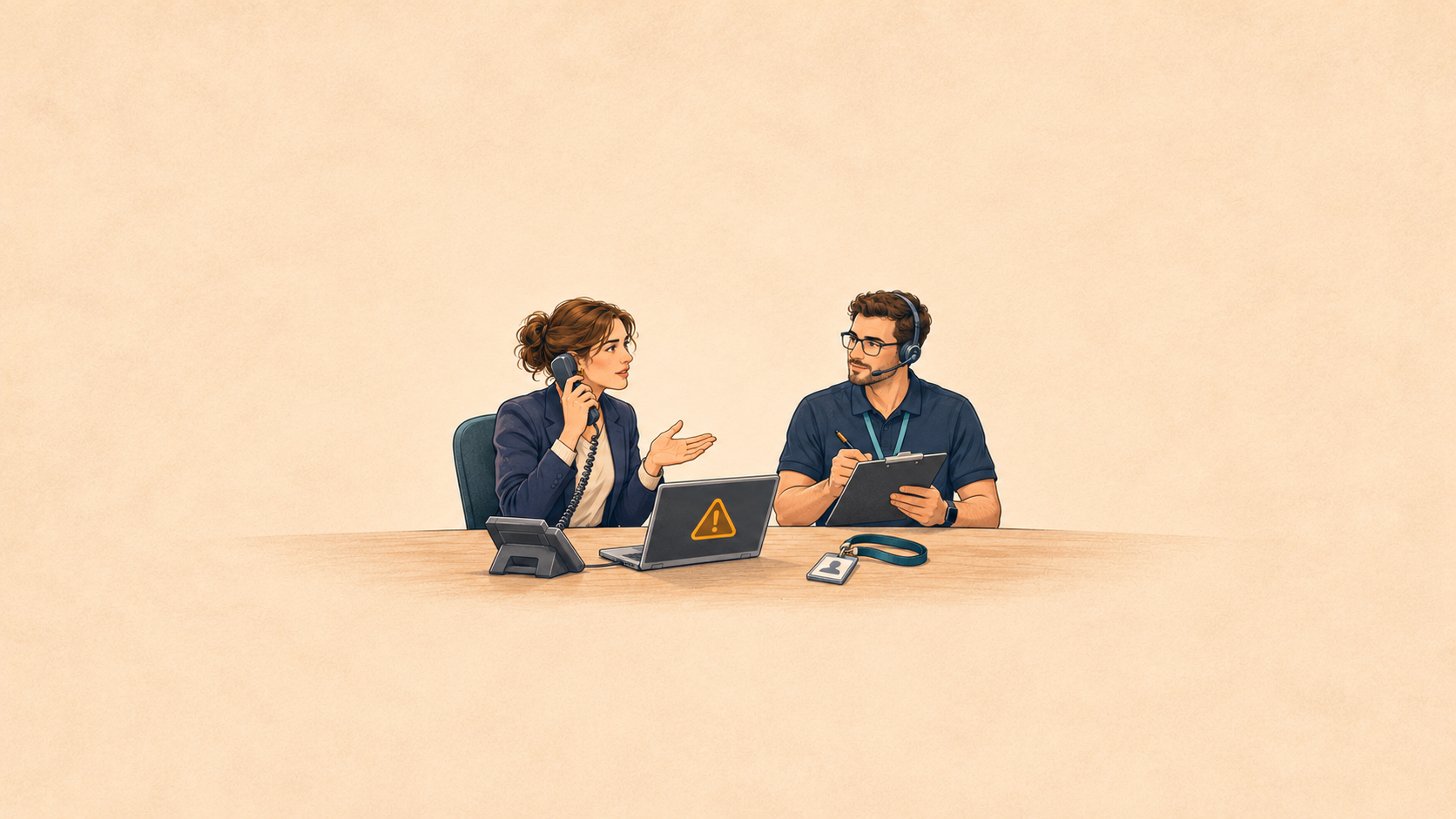
A missing company laptop, an unexpected sharing permission or someone inside a restricted office: employees often notice the first sign that something is wrong. They do not yet know whether it is an attack, a mistake or an innocent deviation. A useful first report is designed for precisely that uncertainty. Its purpose is not to deliver a finished diagnosis, but to hand the observation safely to someone able to decide what happens next. This guide provides a shared reporting template for digital and physical observations. It addresses German organisations and retains German and EU context throughout.
Report observations before asking staff to classify them
A reporting threshold should not require employees to prove that an incident has occurred. An unexpected MFA prompt, a lost access badge or a misaddressed document can be enough to raise a concrete concern where protection may be affected. A slow computer alone does not prove an attack. Employees therefore describe what they observed and why it was unusual; the receiving team determines the category. BSI module DER.2.1 covers the distinction between incidents and operational faults, known contacts and practical instructions. These are IT-Grundschutz module requirements, not a universal statutory reporting deadline for every employee.
Define three recognisable routes. Immediate danger to people follows the local emergency procedure first. A possible information-security incident goes to the designated receiving team. An ordinary operational fault goes to the service desk, which escalates if new evidence appears. Nobody should have to choose between five specialist departments before reporting. Even a misclassified report deserves a safe handover. Training on phishing reporting behaviour adds detail for suspicious messages; the shared first-report process extends beyond phishing to lost devices, access credentials and paper records. Make the distinction visible through examples rather than an abstract taxonomy.
A template with six information fields
Use six fields as a local working template: What was observed? When was it noticed? Where, or on which device, in which room or account? What possible impact is known? What action has already been taken? How can the reporting person be reached safely? A device identifier or room number is more useful than speculation about attackers. Separate the observation time from the suspected starting time. If the start is unknown, record it as unknown. This template is an operational design recommendation, not an official form. Mandatory fields must not prevent an urgent but incomplete report.
An example exercise report reads: “Noticed at 09:12: a project folder is visible to an external account; project reference P17; scope of further sharing unknown; no permissions changed; reachable through the known internal telephone number.” The receiving team can then ask targeted questions. The example avoids real customer information, passwords and unnecessary file contents. Information classification rules support assessment without requiring the reporter to assign a final protection category. Use fictional names and identifiers in training. Only reuse real cases after sanitisation and approval, so that the exercise does not itself spread sensitive information.
 AI-generated
Define the main route, fallback route and acknowledgement
Publish a specific contact instead of saying “inform IT”. Include the approved channel, its staffed hours, a deputy and a fallback that genuinely works. An intranet form is insufficient when the account is locked or the network has failed. An offline contact card may therefore be useful. Verify the number through a trusted directory, not through the suspicious message. Set a local escalation rule for cases where no acknowledgement arrives. A target time chosen for an exercise must not accidentally be presented as a universal legal deadline. Test the route with staff from different shifts.
The receiving team acknowledges the report, assigns a reference and identifies the next contact. It also explains whether the reporter should remain available and which approved actions now apply. An automated ticket number alone does not demonstrate specialist ownership. Where accounts or communication systems may be compromised, the return channel needs checking too. BSI’s escalation guidance recommends available tools suitable for confidential information and tested reporting routes. Connect this arrangement to ransomware preparedness: staff need a clear alternative communication channel, not improvised technical recovery instructions. The reporter should know who has accepted responsibility for the next step.
Three cases spanning digital and physical observations
Case one: an employee receives a sign-in notification although she has not started signing in. She does not approve an additional request, reports the time and account through the trusted channel, and openly describes any information already entered. A printed fictional message is enough for the exercise; never request real credentials. Assess whether the report reaches the right recipient promptly and distinguishes facts from assumptions. A perfect explanation of the attack technique is not the learning objective. In a second round, make the normal reporting channel unavailable. The employee must locate and use the agreed fallback contact.
Case two: a company badge and laptop are missing after an off-site meeting. The first report records the last known secure location, discovery time, known device identifier and teams already contacted. Whether theft occurred remains unresolved. The responsible teams coordinate access blocking, account review and further actions under their procedures. Employees should neither pursue suspected individuals nor start their own investigation. Clean desk and visitor security provides useful prevention scenarios, but does not replace loss reporting. Demonstrate that a physical loss can also expose information or access capabilities, rather than treating it only as an equipment replacement issue.
Case three: an employee notices that a project folder is visible to an unknown external guest. He reports the observed permission without opening additional files or downloading the whole folder as evidence. The responsible administrator checks the actual scope. If an approved immediate action exists, it is performed according to that instruction and its time recorded; otherwise the employee follows the receiving team’s direction. Exercises on external cloud sharing explore this case further. A variation involving an unknown USB drive tests the same reporting logic: record location and time instead of connecting it to discover its contents.
 AI-generated
Protect evidence without investigating independently
“Please preserve evidence” is too vague for untrained staff. It can encourage forwarding malicious attachments, photographing confidential screens with personal devices or deleting suspected malware. Specify actions allowed in your environment instead. A first report normally starts with observations and identifiers already available; further preservation is handled by qualified personnel under an established procedure. The BSI module explains that premature shutdown or deletion can destroy evidence. This is not a universal instruction to leave every affected device running unchanged. Technical decisions depend on the situation, hazards and approved response plan, not a blanket sentence in a course.
Limit recipients to responsible teams and request only information needed for the next decision. A department-wide group chat is not a substitute for a protected reporting channel. Health data, customer documents and complete message histories do not automatically belong in every ticket. With unknown removable media, training must especially avoid rewarding independent investigation. In the role-play, check whether staff honestly mark uncertainty, disclose mistakes already made and still avoid unnecessary disclosure. A concise and accurate observation is more useful than a lengthy report filled with unsupported assumptions and sensitive copies that responders did not request.
Separate internal reporting from external obligations
The internal first report starts assessment; it does not replace a required notification to an authority. Designated specialists determine whether data protection, sector-specific rules or other obligations apply. Employees should therefore not wait for a supposed external deadline before reporting internally. Nor should they independently contact customers, journalists or authorities with unverified information. BSI’s resources for companies distinguish incident handling from reporting. Record who reviews external requirements, who approves decisions and who communicates them. This organisational allocation does not restrict emergency calls where people are in immediate danger. Keep those routes clear and separate in training.
A short exercise with observable outcomes
As a local design example, run a twenty-minute session: explain the reporting card, practise two cases in pairs and review the handover together. One person reports and the other plays the service desk, then they swap roles. Assess four observable outcomes: the correct channel, useful facts, safe boundaries and acknowledged ownership. Avoiding a risky action also counts as success. Documented training evidence should connect content and version, participants and identified understanding gaps. A passed knowledge quiz alone does not show whether the fallback contact can be found under pressure or whether an incomplete report will actually be accepted.
Review more than the reporter’s mistakes. Was the contact card accessible? Did the receiving team respond respectfully? Was ownership transferred across shifts? More useful reports can indicate better awareness rather than declining quality. Also examine missing acknowledgements, unnecessary follow-up questions and blocked fallback routes. Assign an owner and a verifiable completion condition for each defect. Training records and incident case files serve different purposes; rules for retaining training records should not simply be copied to investigation material. This keeps the review focused on learning while maintaining accountability for genuine process defects and the resulting improvements.
Start the pilot with a small mixed group representing administration, remote work and reception. Ask participants to find the contact card without help and submit a report with deliberately missing information. The receiving team adds only what is needed for the immediate decision. Record where terminology is unclear or where the process depends on one absent colleague. After correcting the problem, repeat that exact handover step. Only then roll out the same procedure more widely. The suggested pilot size and exercise duration are organisational design decisions, not statutory training intervals or a prescribed qualification programme.
Connect a standard course to your own reporting route
The ConformBase course on recognising and reporting security incidents covers identifying possible incidents, the importance of prompt reporting and internal reporting routes. The current offer page describes a story course and a micro-series with a final assessment. This can establish shared terms and decision scenarios, but it cannot replace your contact list, on-call arrangements, local emergency procedures or qualified incident response. Add the current reporting card before assigning training and test a concrete scenario afterwards. Rollout is complete only when an employee can safely hand over an observation and the responsible team demonstrably accepts it.
ConformBase
Turn knowledge into training that works.
Bring compliance, privacy and security awareness into a format your people want to complete, with certificates and audit-ready evidence.
Start free trialAsk about custom courses →