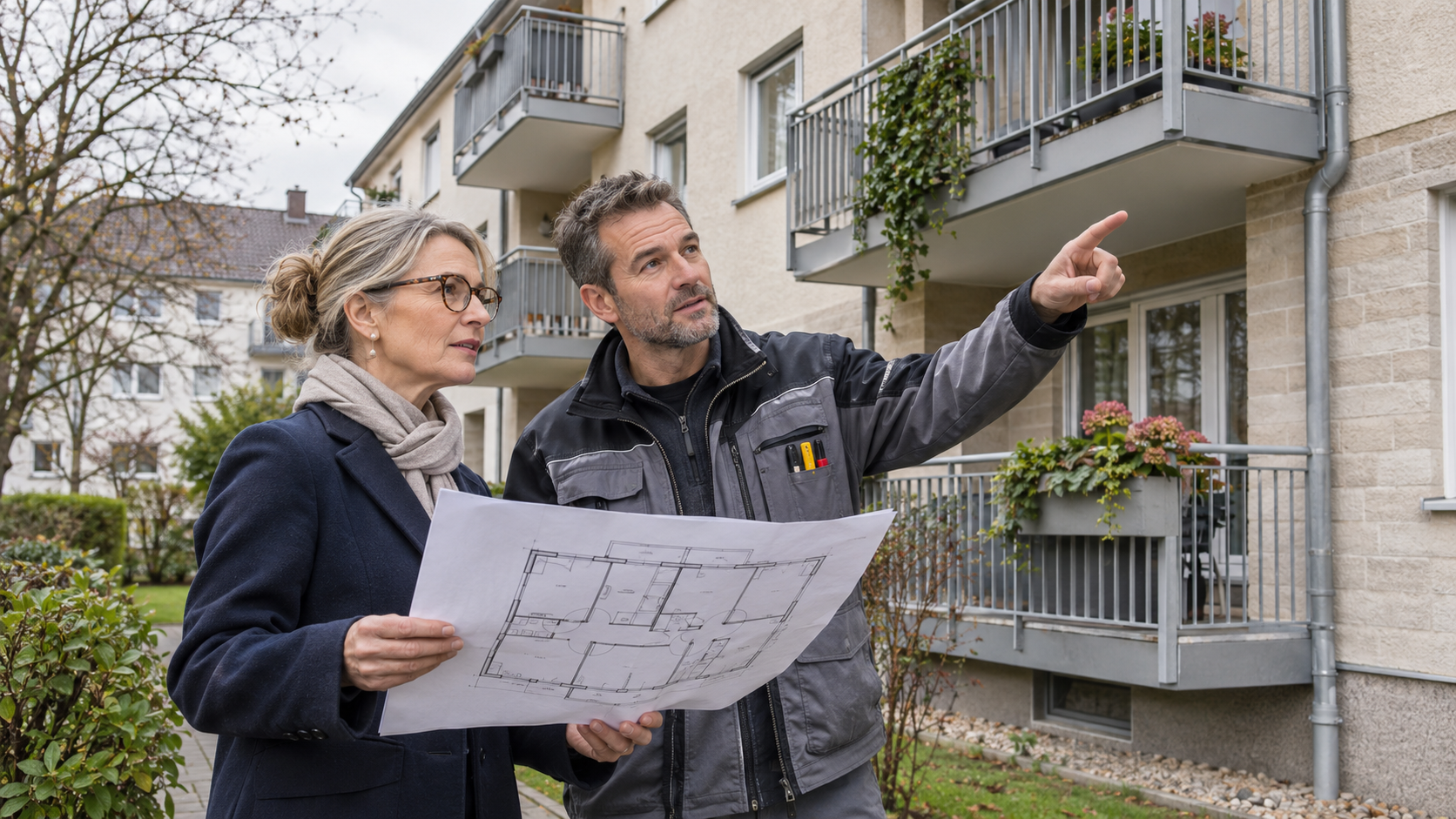
An owner reports water on the living-room ceiling. The neighbour points to the balcony above, accounting asks who must pay, and the contractor wants an immediate order. A manager who simply selects “private” or “association” is deciding too early. The useful first response is structured fact gathering: what is damaged, what function does the component perform, what is immediately at risk, and which documents are missing? Only then can the team reach defensible conclusions about ownership, authority to act and costs. This guide develops a practice exercise with observable outputs for German condominium management.
The exercise concerns associations governed by Germany’s Wohnungseigentumsgesetz, or WEG; it does not import rules from other condominium jurisdictions. It supplements the role-based training plan for property management: reception gathers facts, technical staff identify components, condominium administrators review documents, and the responsible manager acts within their authority. A completion quiz alone cannot demonstrate this workflow. Staff should show that they can turn an initially ambiguous report into a traceable review request without making premature promises. Every case below is fictional. The suggested worksheets are local operating recommendations, not forms prescribed by legislation.
Four questions, not one ownership label
Start with four separate fields: ownership classification, maintenance responsibility, authority for the proposed action, and cost allocation. Identifying a common component does not automatically establish who can commission a particular job today. Conversely, a special cost rule does not turn a common component into individual property. Section 1 WEG defines apartment ownership as individual ownership of the apartment combined with a co-ownership share in common property. This starting point helps correct the assumption that anything inside an apartment belongs exclusively to its owner. Give each of the four answers its own evidence reference rather than hiding everything in one free-text note.
Section 5 WEG is central to reviewing components. Parts necessary for the building’s existence or safety, and installations serving the owners’ common use, cannot be individual property even when physically located within an apartment. The provision also describes when other components can form part of individual property and allows otherwise eligible components to remain common by agreement. Avoid teaching an inflexible list covering “all pipes” or “all balconies”. Staff need to identify the actual part, its technical function and the legally effective allocation for the particular building before recording a conclusion.
Build the review file around the component
Create a compact building file for the exercise: the relevant declaration of division and community rules, the allocation plan, available amendments, relevant resolutions and technical documents. A plan identifies spatial allocation but does not replace legal assessment of a clause. Record the document version and precise location of each passage; a sentence copied from an old email is not a reliable substitute for the complete text. Where documents appear inconsistent, the initial result should be “review pending”. The administrator records the exact unresolved question instead of disguising uncertainty with an apparently definitive stock response.
Also describe the damage separately from its suspected cause. “Damp patch on the ceiling, increasing since Tuesday” is an observation; “failed balcony waterproofing” remains a hypothesis until investigated. Photographs should show the affected area and location, not unnecessarily record private living spaces. The guide to data protection in condominium management supports decisions about necessary information and recipients. Connect photographs, the initial report and the technical response through a case reference. This keeps evidence accessible without circulating entire email chains containing unrelated personal details or treating an occupant’s initial explanation as an established technical finding.
Case 1: Damp beneath a balcony
In the first case, an owner reports a growing damp patch after heavy rain. The team should neither assign the entire balcony to the upstairs owner nor approve complete refurbishment immediately. It separates the visible surface, waterproofing, structural elements and possible junctions into distinct review subjects. Technical staff establish which parts may be affected and whether further immediate damage is threatened. Until then, the appropriate communication is that the cause and responsibilities are under review, while any necessary protective action is assessed separately. This statement does not promise a particular allocation of repair costs.
The case card sets three tasks: obtain a component assessment, identify the relevant building documents, and check authority for the specific action. Section 27 WEG addresses measures of subordinate importance without substantial obligations and measures necessary to meet a deadline or avert a disadvantage; resolutions may restrict or expand these rights and duties. It does not create one universal spending threshold for every management company. The facilitator therefore supplies the competence rules applicable to the fictional building. Where a decision is required, staff hand over a defined proposal to the responsible person rather than a refurbishment order already promised to the owner.
 AI-generated
Case 2: A pipe behind the kitchen wall
In the second case, water drips from an opened inspection point. The resident says the pipe is entirely inside their kitchen and therefore their own responsibility. The team should begin with functional questions rather than agreement or contradiction: which units does it serve, where are its branches, and what does the technical documentation establish? Location alone does not decide ownership. Nor is it enough to say that the pipe can only be reached from this apartment. The exercise is complete only when staff identify the missing technical information and the competent person who can provide it.
For the operational handoff, the team can use a building-operation responsibility matrix without confusing operational roles with legal ownership. A technical contractor can establish the pipe route but does not automatically decide whether a community rule is legally effective. Accounting can identify an existing cost provision without deriving authority to commission work from it. Assess precisely these boundaries during the exercise. A good response identifies the next safe step, the responsible person and the unresolved legal question. A poor response names the invoice recipient quickly while leaving the cause, ownership review and authority unresolved.
Case 3: The exclusively used garden
In the third case, an owner wants to commission construction work on a garden area used exclusively by them. “Only I may enter” proves neither individual ownership nor unrestricted authority to alter it. Staff first check whether the documents establish an exclusive-use right or another allocation. Section 3 WEG permits individual ownership to extend to outside areas of the land under its conditions. Training should therefore neither assume that every garden area is individually owned nor categorically exclude that possibility. The actual, legally effective arrangement for the building remains decisive, and the proposed work needs its own assessment.
Ask the group to draft a response that clearly distinguishes use, ownership and the requested alteration. It identifies the area, the relevant document passage, the proposed scope of work and any unresolved effects on other owners or common components. Where an owners’ resolution may be needed, preparing the owners’ meeting provides the next procedural step. This triage workflow does not replace legal assessment of the intended construction work. For the exercise, a precise handoff is enough: what decision is required, which facts are established, and what technical or legal review must happen before any binding promise?
 AI-generated
Review costs separately and hand them over clearly
A reliable ownership assessment is not a finished accounting allocation. Section 16 WEG sets out the statutory starting point for sharing costs and permits resolutions establishing different distributions for individual costs or categories of costs. Whether a particular agreement or resolution applies to the case and is legally effective requires a separate assessment. Ask learners to place the precise supporting reference beside their proposed cost allocation. “We have always done it this way” is not a basis for approval. Distinguishing maintenance from construction alterations can also be crucial for the subsequent assessment of costs.
The handoff to accounting contains the case reference, proposed measure, approval, reviewed cost rule and expressly unresolved points. The workflow for budgets and annual accounts then supports traceable financial processing; accounting should not have to reconstruct the ownership assessment later from a contractor’s invoice. A local control can require another review of uncertain allocations before costs are finally passed on. This is an operating recommendation, not a universal statutory waiting period. The case file should also show whether initial protective action and subsequent permanent repair were commissioned and assessed separately, with distinct reasons and approval records.
Run a short exercise with clear assessment criteria
For example, allocate forty minutes: ten for individual review, fifteen for comparing role perspectives and fifteen for group feedback. This is a local exercise suggestion, not a statutory minimum learning time. Each group receives the same report but initially incomplete documentation. Additional information is released in response to focused questions. This reveals whether staff actively seek evidence and component functions or merely repeat familiar terminology. Assess their separation of the four questions, the quality of follow-up questions and their handling of uncertainty. Memorising ownership categories alone is not an adequate learning objective for this exercise.
Afterwards, record the case version, participating roles, identified knowledge gaps and agreed follow-up work. The approach to traceable training records helps make the outcome retrievable without copying complete resident files into a learning platform. A reasoned, traceable handoff is a useful completion criterion; any numerical pass mark is your instructional choice. Someone who still confuses ownership with costs should work through a second case with altered facts. Someone who correctly escalates an unresolved question should not score worse than a person who happens to select the expected category. Reliability comes from a process others can examine. Also distinguish different qualification records: successful completion of this internal case exercise evidences that exercise, not automatically a separate professional qualification.
From practice case to everyday work
Under Section 18 WEG, administration of common property rests with the association of apartment owners. Everyday implementation nevertheless requires reachable contacts, deputies and a known route for urgent matters. The legal allocation does not replace that organisation. After the first exercise, review an anonymised real handoff: was the component clearly described, could staff locate the source and approval, and did accounting need to repeat the research? Use problems to improve the local worksheet. Repeat the exercise when relevant changes or knowledge gaps justify it, rather than asserting an annual statutory training requirement that the cited provisions do not establish.
The property-management training offer lists reading the declaration of division and distinguishing individual from common property as a dedicated course topic. Check the current scope for your roles and combine foundational knowledge with documents from the buildings you manage. A course does not decide an individual ownership dispute or replace necessary legal advice. The practical objective is narrower and measurable: staff recognise limits, obtain the right information and hand over a file that supports a decision. The quick question “Who pays?” becomes an appropriate sequence of observation, classification, authority review and an evidenced cost decision. The current training topics also help identify privacy and safety-awareness interfaces when arranging the wider training plan.
ConformBase
Turn knowledge into training that works.
Bring compliance, privacy and security awareness into a format your people want to complete, with certificates and audit-ready evidence.
Start free trialAsk about custom courses →Won through a public tender: AI literacy for DIW Berlin, from kick‑off to sign‑off in one month.